Select a site alphabetically from the choices shown in the box below. Alternatively, browse sculptural examples using the Forward/Back buttons.
Chapters for this volume, along with copies of original in-text images, are available here.


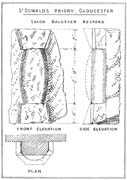
Object type: Baluster shaft
Measurements:
H. c. 78.8 cm (31 in) [capital c. 17.8 cm (7 in); shaft c. 45.7 cm (18 in); base c. 15.3 cm (6 in)]
Maximum diameter of shaft c. 22.9 cm (9 in)
Stone type: (Backing panel) Pale yellowish grey (5Y 8/1), sparry matrix supported, shelly oolite. Ooliths not commonly hollow and range in size from 0.2 mm up to 1.0 mm. Shell debris up to 3 mm. Cleeve Cloud Member, Birdlip Limestone Formation, Inferior Oolite Group, Middle Jurassic.
Plate numbers in printed volume: Ill. 346
Corpus volume reference: Vol 10 p. 220
(There may be more views or larger images available for this item. Click on the thumbnail image to view.)
Baluster shaft from the jamb of a (belfry?) window or a blind arcading. The shaft is bellied with a splayed capital and base and was cut from the same stone as the backing panel. The carving was published by Medland (1888–9, 121, pl. IV); his drawing is reproduced on the illustration pages.
This shaft is similar to the seventh- to eighth-century miniature shafts in the baluster friezes from Jarrow and Hexham (Cramp 1984, 118–19, no. 25, pls. 101.540, 102.547–8; ibid., 186–7, nos. 23, 24, 25, 26, pls. 182.978–82, 183.983–94), a late tenth-century mid-wall shaft from the lower stage of the tower at Barton-on-Humber in Lincolnshire (Taylor and Taylor 1965, i, 54; Everson and Stocker 1999, 102–3, ills.19–22), or the shafts at Worth, Sussex (Taylor and Taylor 1965, ii, 690, fig. 354).
