Select a site alphabetically from the choices shown in the box below. Alternatively, browse sculptural examples using the Forward/Back buttons.
Chapters for this volume, along with copies of original in-text images, are available here.


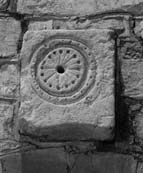
Object type: Sundial
Measurements:
H. 27.7 cm (10.9 in); W. 23.2 < 23.8 cm (9.1 < 9.4 in); D. (visible) 4 < 4.5 cm (1.6 < 1.8 in)
Diameter (of central roundel) 11.8 < 12 cm (4.6 < 4.7 in); (of outer roundel) 16.5 < 17 cm (6.5 < 6.7 in)
Stone type: Yellowish white (5Y 7/1), hard, moderately sorted, medium-grained sandstone. Grains sub rounded and mainly quartz, although some feldspar may also be present (grain size 0.2 to 0.5 mm). Matrix looks pale grey to white in colour, but there may also be the remains of a pale lime wash. Probably Wrekin Quartzite, early Cambrian.
Plate numbers in printed volume: Ills. 730-1
Corpus volume reference: Vol 10 p. 378
(There may be more views or larger images available for this item. Click on the thumbnail image to view.)
Found buried in the church 'at a recent restoration' (Green 1932, 25). The restoration was most probably that of 1882–3, when excavation within the church disclosed the twelfth-century floor level (Kelly 1896, 196).
Circular sundial carved on a rectangular slab, with a curving chamfer cut into the lower face which reflects the line of the arch above which it is now set, but may also relate to the original position of the dial (above the south door?). The roundels are slightly irregular. Between the inner and outer roundels there is a 1 cm (0.4 in) wide, round-bottomed groove, and a similar groove defines the outer edge of the outer roundel. The diameter of the gnomon socket is 3.8 cm (1.5 in), and it is surrounded by 16 inscribed radiating lines each of which ends in a small drilled hole. In the outer roundel there are 24 drilled holes. Around the lower edge of the outer roundel a series of letters and symbols have been incised. The central letter is a broken-crossbar 'A', but the other symbols are more difficult to interpret.
Appendix D item (sundials presumed to be of pre-Conquest date).
Dials divided into 4, 8 or 16 equal segments are generally considered to be of Anglo-Saxon date, with the majority being dated to the tenth or eleventh century. The outer ring of 24 holes suggests that the Pirton dial was 're-calibrated' at a later date. Circular dial are not uncommon, but most are only marked-out in the lower half of the circle. Completely carved dials like Pirton should, therefore, be seen as partly functional and partly decorative.
Inscription Since I have not personally examined this inscription, the following remarks are to be seen as preliminary and tentative only. There is certainly a text that curves round beneath and to each side of the dial. As noted above, the central letter seems to read 'A' and there may be a second letter 'A' below and to its right. Up the right-hand edge there might be an attempt at an omega, and the 'W'-shape to the left of the central 'A' could also be interpreted as omega. Such a possible text can be paralleled on the sundial from North Stoke in Oxfordshire, where the omega also has a 'W'-shape (Okasha 1992, 51–2). The reference is of course biblical, to Revelation XXII.13, and might be seen as quite appropriate to a sundial. Without having examined the text, I am not able to comment on the other letter forms, nor on a possible epigraphical date.
