Select a site alphabetically from the choices shown in the box below. Alternatively, browse sculptural examples using the Forward/Back buttons.
Chapters for this volume, along with copies of original in-text images, are available here.


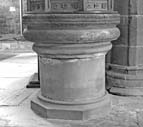
Object type: Font1
Measurements:
H. (incl. base and shaft) 112 cm (44 in); font 46 cm (18 in); shaft 46 cm (18 in); current base 20 cm (8 in); W. (external diam.) 113 cm (44.4 in); (diam. of column shaft) c.77 cm (30.3 in)
Font bowl: W. (internal diam.) 57 > 54 cm (22.4 > 21.2 in); (small inner bowl) 24 cm (9.4 in); D. (main bowl) 21 cm (8.3 in); (small inner bowl) 9.5 cm (3.7 in)
Stone type:
a. (font cut into inverted Roman column base): Pale red to pale reddish brown (10R 6/2 to 10R 5/4), fine to medium-grained (0.2 to 0.3 mm) sandstone.
b. (shaft of font — reused column): Pale red to pale reddish brown (10R 6/2 to 10R 5/4), medium to coarse-grained (0.3 to 0.6 mm) sandstone.
In both the grains are dominantly of quartz but with some mica, a little feldspar and some reworked rock grains, possibly of volcanic origin. The quartz grains are sub-angular to rounded. Probably a sandstone from within the Salop Formation, Warwickshire Group of the Upper Carboniferous.
Plate numbers in printed volume: Ills. 762-3
Corpus volume reference: Vol 10 p. 389-90
(There may be more views or larger images available for this item. Click on the thumbnail image to view.)
This font (stone type 'a' above) has been cut into a reused (inverted) Roman column base (not a capital as is often proposed), set on top of what may be a section from a Roman column (stone type 'b' above). The column shaft sits on a later octagonal base. The double torus moulding and basal mouldings around the upturned Roman column base are complete and unaltered. The bowl of the font itself is lead-lined and has sloping sides and a flat bottom, in the centre of which there is a smaller, integral bowl that is semi-circular in section with a central drainage hole.
Appendix K item (Fonts and stoups in the Western Midlands).
This font is one of a small group of fonts in central Shropshire made from reused column bases and capitals from major Roman buildings. Others include Wroxeter St Andrew 5 (p. 390, Ills. 768–70), Wallstaston 1 (p. 386, Ills. 756–7) and Smethcott 1 (p. 386, Ills. 753–5). They probably came from the Roman town of Viroconium that is about four miles south-east of Shrewsbury. Stocker has suggested that there may have been more to this reuse than mere convenience of shape: 'It would be naively patronising to think that the medieval mind would not have perceived the symbolic significance of the transportation and "conversion" of [these] fragment[s] from a pagan building at Viroconium to [one of] its Christian successor[s]' (Stocker 1997, 22). If Viroconium/Wroxeter was the seat of a British bishop in the fifth–seventh centuries, as proposed by White and Barker, then this might offer an additional reason for reusing stones from the site (Barker et al. 1997, 237–8, 247; White and Barker 1998, 121, 123–6; White 2007, 205–6).
The Shrewsbury Abbey font and that from St Andrew's, Wroxeter could originally have stood on the ground or a low plinth, as is presently the case at Woolstaston and Smethcott, rather than on their present shafts; see also Preston 1, Gloucestershire and Kenchester 1, Herefordshire in this Appendix (pp. 384, 382), and Chapter V, Further thoughts on fonts (pp. 62–4).
[1] There are, beside the Deerhurst font in Gloucestershire which has been shown to be of ninth-century date (Deerhurst St Mary 3, p. 163, Ills. 132–44, 740), a number of fonts in the study area that have been said to be Anglo-Saxon or could be Anglo-Saxon. There are also objects like Bisley All Saints 6 (below, Ills. 732–4) that has been described as a font fragment, and Kenchester 1 (p. 382, Ills. 735–6) that now functions as a font, but that are much smaller than all of the other vessels and may, therefore, have originally been used as stoups or lavabo bowls (see below, and 'Further thoughts on fonts' in Chapter V, pp. 62–4, Table 1). In the following Appendix three vessels that were probably stoups have been listed first, followed by the fonts in chronological order by form (cylindrical tub fonts, square tub fonts, tapering or cone-shaped fonts, and bowl-shaped fonts). Some clearly belong to the Overlap period but are included because they show continuity of form and decoration into the later decades of the eleventh century and beyond.
The tub font at Deerhurst is the earliest securely datable font, and an eighth-century Anglo-Saxon ivory panel in the Victoria and Albert Museum that depicts the baptism of Christ also show a tub font (Beckwith 1972, 119, cat. 5, ill. 20). Tub fonts have, therefore, been placed first in the catalogue below. However, in the south-west of England the earliest surviving fonts are bowl-shaped (copies of domestic bowls) and it seems inherently likely that both tubs and bowls were in use at the same time (Cramp 2006, 38; Blair 2010).
Many of the western Midlands fonts seem to have been carved from newly worked stone, but several are carved into reused Roman capitals and bases. One of the reused Roman bases (at Woolstaston, Shropshire), almost certainly came from the Roman city of Viroconium (Wroxeter) but, unlike the similarly reused bases at Wroxeter St Andrew and Shrewsbury Abbey (pp. 390, 389, Ills. 762–3, 768–70), this vessel has been very crudely reshaped and the bowl is only 8 cm deep (p. 386, Ills. 756–7). It does not look like a font at all but it would, in fact, be ideal for the baptism of adults by affusion or aspersion. Adult baptism must have been very rare by the later Anglo-Saxon period, so it seems possible that the Woolstaston font might be very early, perhaps even sub-Roman.
