Select a site alphabetically from the choices shown in the box below. Alternatively, browse sculptural examples using the Forward/Back buttons.
Chapters for this volume, along with copies of original in-text images, are available here.


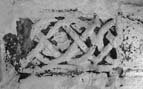
Object type: String-course fragment
Measurements: H. 25.4 cm (10 in); W. 56.5 cm (22.2 in); D. unknown
Stone type: Sandstone, fairly hard, fine- to medium-grained (0.2 to 0.4 mm), greyish orange pink (5YR 7/2). Grains mainly quartz, poorly sorted, sub-angular to sub-rounded. Grinshill Sandstone which is a variant of the Helsby or Bromsgrove Sandstone formations, part of the Sherwood Sandstone Group and middle Triassic in age.
Plate numbers in printed volume: Ill. 557; Fig. 20Q
Corpus volume reference: Vol 10 p. 311-2
(There may be more views or larger images available for this item. Click on the thumbnail image to view.)
Interlace-decorated string-course fragment. The carving is in low relief, bounded at the top and bottom by narrow borders. The interlace is plain and narrow, and consists of a series of looped, mirror-image, interlocked knots with a lozenge shape at the crossing, sometimes called Carrick Bends (simple pattern F).
Roger White, who made rubbings of the carvings when they were discovered in the 1990s, has reconstructed all three of the Mardol fragments (nos. 1–3) as a single section of string-course, with no. 2 at the left end and no. 1 at the right end (unpublished material from Shrewsbury Museum and Art Gallery). No. 1 is a terminal block, with a blank section beyond the end of the carving. The blank section is roughly carved and was presumably embedded in a corner. There is no way to tell if the string-course continued around the corner, but if it did the design must have started anew. The surviving overall length of the carved face is c. 125 cm (49.1 in), with nos. 1 and 3 probably joining, and about 13 cm (5.1 in) of lost stone between nos. 2 and 3.
The simple pattern F interlace motif is widespread and long-lasting. Examples can be found on a ninth-century cross from Ramsbury, Wiltshire (Cramp 2006, 228–9, ills. 486, 489); on a late ninth-century fragment from Leeds, west Yorkshire (Coatsworth 2008, 206–7, ill. 524); a tenth-century cross from Waberthwaite, Cumbria (Bailey and Cramp 1988, 151–2, ill. 585); tenth-/eleventh-century fragments from Lewknor, Oxfordshire (Tweddle et al. 1995, 216–17, ills. 316–17) and Marton, Lincolnshire (Everson and Stocker 1999, 228–9, ills. 294–9); and, with pelleting, on an eleventh-century carving from Bibury, Gloucestershire (no. 4, p. 137, Ill. 35). The Mardol fragments are well-executed, and a tenth-century date would seem most appropriate (see below).
The building at 50 Mardol was built, probably in the 1790s, with brick above ground and a stone cellar composed of reused masonry (see above, Evidence for Discovery). In 1788 the tower of Old St Chad's church collapsed, taking with it much of the rest of the surrounding structure. 'When the ruins were cleared the process was watched by two people with a deep interest in the town's history: Rev. Hugh Owen and Henry Pidgeon. . . They both noted early — they thought Anglo-Saxon — sculptural fragments reused as rubble in the core of the medieval walls' (Baker 2003, 31–4). Baker suggests that the reused masonry (including the sculptural fragments) at 50 Mardol may, therefore, have come from Old St Chad's. St Chad's was one of several important pre-Conquest churches in Shrewsbury (Bassett 1991). In Domesday Book St Chad's appears as an episcopal college, the property of the bishops of Lichfield (and after 1075 of Chester) (Thorn and Thorn 1986, nos. 1,2; 1,4; 3f). Bassett (1991, 3–7, 14–16) has argued that there is circumstantial evidence which strongly suggests that St Chad's was a major minster of Middle Saxon origin, in all likelihood an episcopal foundation from the outset. The Mardol sculptural fragments would be perfectly 'at home' in such a church. Baker noted that the carving was sharp and unweathered (Baker 1994a, 1), suggesting that this piece and nos. 2 and 3 originally came from an interior string-course.
