Select a site alphabetically from the choices shown in the box below. Alternatively, browse sculptural examples using the Forward/Back buttons.
Chapters for this volume, along with copies of original in-text images, are available here.


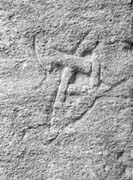
Object type: Trial-piece or graffito
Measurements: H. (of carving) 11.5 cm (4.5 in); W. (of carving) 9.5 cm (3.7 in)
Stone type: Yellowish grey (5Y 7/2), poorly sorted, matrix-supported, shelly oolite. Most of the ooliths have fallen out to give an 'aero-chocolate' texture. The ooliths range from 0.2 to 0.6 mm, but are mostly between 0.3 and 0.5 mm; they form about 50% of the rock. Elongate shells up to 5 mm across and sub-rounded shells up to 3 mm across form about 20% of the rock. Ardley Member?, White Limestone Formation, Great Oolite Group, Middle Jurassic.
Plate numbers in printed volume: Ills. 429-30
Corpus volume reference: Vol 10 p. 246
(There may be more views or larger images available for this item. Click on the thumbnail image to view.)
Revealed during the unblocking of the north doorway of the nave on 19–22 April 1968 (Taylor 1969, 71).
Two interlocking ellipses carved in incised lines on the door jamb. The ellipses are sharply pointed at one end and have curling, rounded terminals at the other end. Two of the zones inside the inscribed outlines have been cut more deeply.
In design terms, this small carving makes no sense in relation to its position on the edge of the jamb, and it is probably a trial-piece or a graffito. Taylor suggested that the carving might have been an attempt to form two superimposed triquetra, abandoned because it did not work out as planned (Taylor 1969, 71). The curling terminals are similar to the eyebrow terminals on the ninth-century animal heads from St Mary's, Deerhurst (nos. 13–14, 16–19, Ills. 180, 187, 194, 205) or the tenth-century bear's head from the Tolsey in Gloucester (Ill. 377), and this might give some idea of the date of this little piece.
