Select a site alphabetically from the choices shown in the box below. Alternatively, browse sculptural examples using the Forward/Back buttons.
Chapters for this volume, along with copies of original in-text images, are available here.


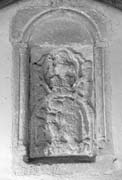
Object type: Carved panel
Measurements: H. 74 cm (29 in); W. 39 cm (15.3 in); D. unknown
Stone type: Pale yellowish orange (10YR 8/2), poorly sorted, matrix-supported, shelly oolite. The ooliths range from 0.3 to 0.7 mm, but mostly are in the range 0.4 to 0.5 mm; about half have fallen out — they form about 50% of the rock. Shell fragments are mostly sub-rounded, but a few platy fragments are up to 2.5 mm — they form about 25% of the rock. Taynton Limestone Formation? Great Oolite Group, Jurassic.
Plate numbers in printed volume: Ills. 437-40; Fig. 32C
Corpus volume reference: Vol 10 p. 247-9
(There may be more views or larger images available for this item. Click on the thumbnail image to view.)
A south aisle was added to the church in 1861–2 by J. P. St Aubyn (Verey and Brooks 1999, 617–18), and in the course of this addition, the south doorway of the nave was moved to the new south aisle. There does, however, seem to be no reason to doubt that the reconstruction faithfully followed the original and that the panel has been an integral part of the doorway since the twelfth century.
Carved panel, within a separate architectural frame, and set where one might normally expect to find a tympanum above the south door. This is an ambitious piece carved in high relief, with the background cut back by up to 3 cm. The carving depicts Christ in Majesty above a scene showing the Harrowing of Hell. The separate outer frame consists of two flanking columns, with double-element capitals surmounted by square-section abacii and double-element bases on square plinths. There is a simple roll-moulding below the capitals and above the bases. The columns support a semi-circular arch, with a round cross-section, that encloses a small, plain tympanum. The arch and tympanum have been carved from a single slab of stone.
In the upper zone of the carved panel, Christ sits in majesty upon a throne. The throne has narrow recessed panels on the front and cable decoration on either side. Christ wears a long cloak thrown open to show a full-length, long-sleeved tunic, belted at the waist. The folds of the tunic fall across Christ's knees in elaborate swirling folds. His feet, resting on the arch of the scene below, show beneath the hem of his tunic. Christ holds a book in his left hand and his right hand is raised in blessing. He has a full beard and his hair falls in heavy curls down onto his shoulders. His face is rounded. The nose is now missing and his eyes are badly damaged, but the raised eyebrows still survive as does the outer part of his right eye. Behind his head there is a cruciform halo. Christ sits within a mandorla that is supported on either side by two bearded figures who stand on the arched frame of the lower scene. The top point of the mandorla frame has been cut off, presumably when the panel was reset within its present frame.
In the lower zone the figure of Christ bends forward to beat down the powers of Death and Satan. As with the Christ in Majesty, he wears a long cloak and a full-length, round-necked, long-sleeved tunic. Both cloak and tunic fall in heavy folds. Christ's head is tilted forward almost horizontally, and he wears a cruciform halo. His face is turned towards the front, and he has a moustache and beard. The details of the face itself are very worn, but the large, rounded eyes with high-arching eyebrows can still be seen. His hair is braided across the top of his head and fall in a long, bound plait across his left shoulder. He holds a long-shafted cross in his left hand, and with his right hand helps up a figure that is looking up into Christ's face. Behind the figure that is being lifted up stands a second figure with bent arms and hands seemingly held up in prayer. The head of this second figure is drawn out backwards into a broad fan shape, perhaps a hood, with a tassle hanging down behind the neck. Above the heads of the two smaller figures there is a strange device that consists of four radiating oval shapes below a horizontal bar which has two upward projections, one round and one triangular. The horizontal bar might be the outstretched wings of a bird, with the rounded central projection being its head and the triangular projection its tail. Below Christ's feet there is a figure lying down with his arm and hand pressed, possibly bound, against his side. In each of the lower corners of the frame are rounded, heavily worn shapes that might be the tips of the jaws of Hell. The arched frame above this lower scene is supported on slender round columns with simple rounded bases and tapering capitals.
This small panel is a tour-de-force of carving, intense and dynamic. As indicated above, the panel seems to have been originally intended for another location, as part of the design has been cut away to fit into its present late eleventh- or twelfth-century frame. This fact alone suggests that the panel must be an Anglo-Saxon carving, and that the image in the lower register at South Cerney should be compared with the larger Harrowing of Hell in Bristol Cathedral for which Rosemary Cramp has recently supported a date in the first half of the eleventh century (Cramp 2006, 145–6, ill. 198; see this volume, Ill. 786). It should, however, be acknowledged that the figure of Christ seated within the mandorla in the upper register of the South Cerney panel is in many respects very similar to that on the twelfth-century Eastleach tympanum (Gloucestershire), although at Eastleach the supporting figures (in this case angels) are carved in a markedly different syle.
There are many manuscript parallels for two related elements shown one above the other, for example Christ in a mandorla supported by angels above the scene depicting the martyrdom of Stephen, on fol. 17v in the late tenth-century Benedictional of St Æthelwold (Prescott 2002). The four apostles from the early ninth-century Book of Cerne offer examples where the lower image is within an arched frame (Brown 1996, pls. I–IV; see this volume, Ills. 773–4). The closest parallel for the Harrowing of Hell depiction, albeit without the accompanying Christ in Majesty, is, however, so similar that it seems possible that a common source might have been used. This is the coloured drawing on folio 14 of the mid eleventh-century Tiberius Psalter (BL, Cotton MS Tiberius C. VI). Here, in the mirror image of the South Cerney figure, is Christ in exactly the same pose bent forwards at the waist with his head almost horizontal and his face turned towards the viewer. He has a cruciform halo, a beard and moustache, and his hair is tied back with a band that is knotted around his forehead. He does not carry a long cross, but he reaches down to pull four men and a woman up out of the Jaws of Hell. Christ's clothing falls in heavy, exaggerated folds, while under his feet lies the bound figure of Satan. Above Christ's head, breaking into the scene across the border, are the flames of the sun (Backhouse et al. 1984, 83, cat. 66, col. pl. XX). On the South Cerney stone, the figure below Christ's feet is clearly Satan, while the figure being pulled out of the Jaws of Hell might be Adam, with Eve behind him wearing a hooded garment. Smith, in his valuable analysis of the Bristol Harrowing of Hell (Smith 1976, 102), addresses one of the sources for such images when he quotes from the Anglo-Saxon poem concerning Christ and Satan, of which the second half deals with the Descent into Hell:
The Lord himself has laid low the fiend ...Then he caused the blessed souls, the raceof Adam, to rise up; and Eve could not yet lookupon heaven till she uttered the words'I angered thee once, eternal God, when Adamand I through the serpent's malice ate twoapples, as we should not have done ...(Satan) is now firm in fetters'.(trans. Gordon 1954, 131–2)On the South Cerney panel, the symbol above the heads of Adam and Eve, if this is who they are, is probably intended to depict the Light of the Sun or, if the shape above the four radiating elements is a bird, the Holy Spirit as explained by another passage, this time from the Gospel of Nicodemus, quoted by Smith (Smith 1976, 103).
We, then, were in Hell together ... and at thehour of midnight there rose upon those darkplaces as it were the light of the sun, and shined,and all we were enlightened and beheld one another... The prophet Esaias (sic) being therepresent said: 'This light is of the Father and ofthe Son and of the Holy Ghost, concerningwhich I prophesied when I was yet alive...'.(trans. James 1953, 123–4)Jane Hawkes also addresses the events associated with Christ's descent into Hell in her analysis of the iconography of the sequence of scenes depicted on the grave-cover from Wirksworth in Derbyshire (Hawkes 1995, 255–6, 267–8). 'Christ in his humility descends into Hell to release Adam and his kin from bondage; as the dead were resurrected and led to heaven by Christ, so too will faithful Christians be rewarded with eternal bliss at the time of the Final Resurrection, a process commemorated in the dialy celebration of the Eucharist, and the rituals of Baptism' (ibid., 268).
The Christ in Majesty miniature which occurs on fol. 18 of the Tiberius Psalter shows Christ seated in a mandorla flanked by two angels (Temple 1976, 115–17, cat. 98, ill. 302). The depiction of Christ in this miniature is not exactly like the South Cerney figure (he holds a flaming horn and a cross as well as a book and he is not raising his hand in blessing), but the figure of Christ the Judge in the Trinity College B manuscript of Anglo-Saxon Homilies from the first half of the eleventh century has all the attributes seen at South Cerney (Temple 1976, 92, cat. 74, ill. 241).
Below the mandorla in the Tiberius Psalter miniature, two saintly clerics flank an archangel, not actually supporting the mandorla but looking up towards Christ. Figures that do support the mandorla of Christ in Majesty or Christ the Judge, but are not angels, can be found in the late tenth-century Homilies on Ezekial by St Gregory (St Gregory and St Benedict on fol. 149 of Orleans, Biblioth?que Municipale MS 175 — Temple 1976, 66, cat. 43, ill. 144) or in the Gospel Lectionary dated to the first half of the eleventh century now in Florence (St Peter and St Paul on fol.1 of Biblioteca Medicea Laurenziana MS Plut. XVII. 20 — Temple 1976, 88, cat. 69, ill. 232). In the case of the South Cerney panel, the two supporting figures might be St Peter and St Paul. Alternatively, it is possible that the artist has added yet another layer of symbolism to the panel and incorporated a reference to the Transfiguration, with the two figures being Moses and Elijah.
The rounded bases and tapering capitals on the slender columns that support the arch above the lower image at South Cerney can also be paralleled in manuscripts from the first half of the eleventh century (for example on the portrait of John from the Gospel Lectionary (or St Margaret's Gospels), Bodleian Library MS Lat. lit. F. 5 — Temple 1976, 106–7, cat. 91, ill. 280).
The history of the South Cerney estate in the late tenth and eleventh centuries is set out under no. 1 above. Any of the various high-status patrons who held this estate would make suitable patrons for this fine carving.
