Select a site alphabetically from the choices shown in the box below. Alternatively, browse sculptural examples using the Forward/Back buttons.
Chapters for this volume, along with copies of original in-text images, are available here.


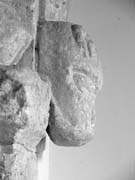
Object type: Animal-head label stop
Measurements: H. 26 cm (10.2 in); W. 15 cm (5.9 in); D. 13 cm (5.1 in)
Stone type: (Lime plastered and difficult to find a fresh surface.) Very pale orange (10YR 8/2), poorly sorted, matrix-supported, shelly oolite. Ooliths range from 0.3 to 0.6 mm, but are mostly between 0.4 and 0.5 mm; all have fallen out to give an 'aero-chocolate' texture — they form about 50% of the rock. Shell fragments up to 2.5 mm form about 15% of the rock. Taynton Limestone Formation?, Great Oolite Group, Jurassic.
Plate numbers in printed volume: Ills. 480-1
Corpus volume reference: Vol 10 p. 264-5
(There may be more views or larger images available for this item. Click on the thumbnail image to view.)
The two beast heads South Cerney 3 and 4) form part of the south doorway, which was moved to its present position in 1861–2 (see South Cerney 2, p. 247). Like the panel in the tympanum, the beast heads are likely to have been part of the doorway since the twelfth century, and are clearly shown on a Samuel Lysons engraving of 1804 (reproduced in Oakeshott 2001, 36).
The beast's head is keyed into the wall at the top while the muzzle is pendant. The head is rectangular with a heavy roll moulding around the end and sides of the muzzle, giving the effect of a luxurious moustache, or as if the lips are turned back in a snarl. The nose is long and triangular. The eyes are elliptical and bulbous, and set below clearly defined brows that meet just above the top of the nose in a sharp ridge. The forehead is rounded and the rounded ears are laid flat back across the top of the head. The top of the stone is flat and semi-circular in plan as though it was originally pendant to a simple roll moulding.
Appendix A item (stones dating from Saxo-Norman overlap period or of uncertain date).
This label stop and its pair to the west (no. 4) sit most uncomfortably in their present positions. They are not quite in line with the hood-moulding above the door, and the ends of the twelfth-century impost stones needed to be trimmed back to accommodate their pendant jaws. Many commentators have marked on the difference in quality between the beast heads and the rest of the door-head. The present author feels that the difference is more one of style than quality, and this might be explained if the beast heads were surviving elements of an earlier, late Anglo-Saxon structure reset in their present positions at some time after the eleventh-/twelfth-century doorway was first constructed. It should be noted that there is an animal-head corbel in the tower that shares many of the features of the two south door beast heads. This corbel looks rather more twelfth century, but it has been heavily 'restored' and the details cannot be fully relied upon. An eleventh-century date for the two south door beast heads seems quite probable, but whether before or after the Conquest is more difficult to say.
