Select a site alphabetically from the choices shown in the box below. Alternatively, browse sculptural examples using the Forward/Back buttons.
Chapters for this volume, along with copies of original in-text images, are available here.


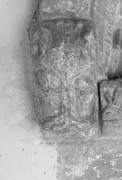
Object type: Animal-head label stop
Measurements: H. 27 cm (10.6 in); W. 16 cm (6.3 in); D. 12 cm (4.7 in)
Stone type: (Lime plastered and difficult to find a fresh surface.) Very pale orange (10YR 8/2), poorly sorted, matrix-supported, shelly oolite. Ooliths range from 0.3 to 0.6 mm, but are mostly in the range 0.4 to 0.5 mm; most have fallen out to give an 'aero-chocolate' texture — they form about 35% of the rock. Shell fragments vary from sub-rounded to platy and up to 8.0 mm and form about 35% of the rock. Taynton Limestone Formation? Great Oolite Group, Jurassic.
Plate numbers in printed volume: Ills. 482-3
Corpus volume reference: Vol 10 p. 265
(There may be more views or larger images available for this item. Click on the thumbnail image to view.)
As with South Cerney 3, the head is keyed into the wall at the top while the muzzle is pendant. The beast is the pair to no. 3 with a similar rectangular head and heavy roll moulding around the end and sides of the muzzle. The nose is long and tapering. The eyes are elliptical and bulbous, and slightly different sizes. The top of the nose runs straight up into a fairly sharp brow ridge. The forehead is rounded, and the rounded ears are laid flat back across the sloping top of the head.
Appendix A item (stones dating from Saxo-Norman overlap period or of uncertain date).
See South Cerney 3.
