Select a site alphabetically from the choices shown in the box below. Alternatively, browse sculptural examples using the Forward/Back buttons.
Chapters for this volume, along with copies of original in-text images, are available here.


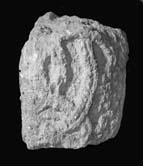
Object type: Architectural carving: screen respond?
Measurements: H. 18 < 19 cm (7.1 < 7.5 in); W. 29 cm (11.4 in); D. 14.5 cm (5.7 in)
Stone type: Very pale orange (10YR 8/2) oolitic very shelly limestone, clast supported, sparry matrix. All ooliths hollow, ranging between 0.2 to 1.0 mm in size. Shell debris up to 20 mm. Bivalves, e.g. oysters and ?gastropods. Cleeve Cloud Member, Birdlip Limestone Formation, Inferior Oolite Group, Middle Jurassic.
Plate numbers in printed volume: Ills. 672-6; Fig. 18F
Corpus volume reference: Vol 10 p. 368
(There may be more views or larger images available for this item. Click on the thumbnail image to view.)
Fragment of an attached shaft with a central 'V'-shaped slot 4 cm deep and dividing two zones of decoration. To one side of the slot (face A) the quarter-round surface is decorated with a tangle of median-incised interlace and a long, triangular berry bunch which terminates in a hooked-tipped shoot. To the other side of the slot (face B) the quarter-round surface is also decorated with median-incised interlace, but on this face there is a flat-profile border that runs up the edge of the slot. The background is cut back by about 1 cm on both carved faces.
This fragment may have been part of the support for a screen (J. West in Guy 1994, 24, fig. 21). The carving is of tenth-century date and it is, therefore, possible that this fragment came from the cathedral church of St Mary begun in the 960s by Bishop (Saint) Oswald and completed by 983 (see also the capitals and bases, Worcester Cathedral 3a–x, below). In the collection of carved stones at St Illtud's in Llantwit Major in south-east Wales there is a tall cylindrical column, the surface of which is completely covered with interlace carving except for a vertical slot in one face. There is also a fragment of a second column. Redknap and Lewis suggest that these stones were 'architectural elements of the church'. They acknowledge that the pair might have been the supports for a screen but feel that the height of the column (206 cm / 81 in) militates against this possibility (Redknap and Lewis 2007, 390–4, cat. and ills. G67 and G68). The overall decoration of these columns shows that they were clearly designed to be seen from all sides and could, therefore, have acted as 'responds' for screen walls, perhaps linking the columns to the side wall of the church. However they were used, it does seem that the Llantwit Major columns served a similar purpose to the Worcester fragment, as decorated supports for screening panels or walls.
