Select a site alphabetically from the choices shown in the box below. Alternatively, browse sculptural examples using the Forward/Back buttons.
Chapters for this volume, along with copies of original in-text images, are available here.


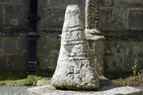
Object type: Grave-marker?
Measurements: H. 84 cm (33 in); W. 11 < 48 cm (4.25 < 19 in); D. 52 cm (20.5 in)
Stone type: Heavily lichen-encrusted and difficult to find a clean surface. There are scattered equidimensional quartz crystals up to 4 mm across, together with small feldspar phenocrysts up to a maximum of 1 cm by 3 cm. Probably Carnmellis Granite, but it could possibly be from a fine-grained facies of the Land's End Granite.
Plate numbers in printed volume: Ills. 252-5
Corpus volume reference: Vol 11 p. 213-4
(There may be more views or larger images available for this item. Click on the thumbnail image to view.)
Irregular pyramid-shaped granite pillar of trapezoidal cross-section, with a slightly concave profile and short tenon on the top. Decorated on one face only; the other three faces are unworked and an eroded fissure on one face shows the origin of the stone as surface granite from a tor or outcrop.
A (main face): Evenly tapering triangular face with a slightly concave outline. This is the stone's widest face; it features decoration in the form of three nearly-horizontal bands, and at the bottom, an incised cross. The three bands are formed of two parallel incised lines approximately 2 cm (0.75 in) apart. They are not horizontal, but cut at a slight slant going up from left to right as though intended to spiral all around the stone, but in fact they stop just around the corner from the main face. Below the bottom band is a simple cross, cut in a broad incised line, 12 x 12 cm (4.75 x 4.75 in).
B, C and D: Undecorated
Appendix A item (stones of uncertain date)
Although of rather irregular shape, the stone appears neatly dressed with the very simple ornament all laid out as a piece to fit the stone. Even though it is a possibility, suggested by Thomas (Thomas, A. C. 2007, 124) and pointed out in Chapter VI of the introduction, that an incised cross can be added at any time to 'Christianise' a monument, the fact that the horizontal lines and the cross are all cut to a similar depth may suggest that they are coeval. The fact that the decoration appears on one side of the stone only suggests that it was intended to be viewed from one side only. On the top, the very slight tenon indicates that only a small extra piece of stone could have sat securely on it.
The stone is something of a mystery. There are no obvious parallels for a free-standing monument like this in an ecclesiastical context in Cornwall, although a number of different ideas have been put forward. For the first person to record the stone, it was 'a peculiar form of hewn rock, somewhat in the shape of a sugar-loaf' (Cornish 1886–7, 225) but no suggestions were made as to its origin. The second observer thought that it was 'only a stone used for rickyard purposes' (Bicknell 1910, 48). Finally, a theory recently published by Charles Thomas proposes that the stone might be an Iron Age st?le (Thomas, A. C. 2007).
The description of the stone as 'for rickyard purposes' implies that it was considered to be what is more commonly known as a staddle stone. With a cap on so that it resembled a giant mushroom, and in a group of such stones, it would have been used to support a raised granary. Although the idea is given no credence by Thomas (Thomas, A. C. 2007, 121) it nonetheless deserves consideration, since St Erth 3 is of the right height and tapering shape for this. Staddle stones are normally of circular or square cross-section, although rectangular and irregular examples are known, and while the top is normally flat with the circular stone cap simply placed on top, examples are known in Cornwall with a tenon on the top, over which a circular disc of slate with a hole in the centre could be slotted. In many ways this theory is the best fit, although against it is the fact that no decorated examples are known, and none with a cross: however this decoration might perhaps be explained as appropriate to a tithe barn. On the other hand, the fact that the stone is said to have been discovered in the wall of the church while it was being restored seems to tell against such an origin, as staddle stones are normally considered to be of eighteenth- or nineteenth-century date.
Leaving the farmyard for a more purely ecclesiastical context, the only possible parallels for a stone of this shape are the pyramidal pinnacles crowning the towers of certain Cornish churches, examples in west Cornwall being St Levan and Sennen, although this is dismissed by Thomas (Thomas, A. C. 2007, 124). These pinnacles, invariably crowned by a stone ball, would require a socket and tenon joint or some means of fixing the finial. St Erth's church tower now has crocketted pinnacles which Blight (1885, 129) notes are an addition to the fourteenth-century tower, so it is not impossible that the simpler earlier style was replaced with the present more elaborate version. However, as the present writer has never seen one of these pyramids close up and in situ, it remains uncertain whether they are of similar size and decoration.
At the opposite end of the spectrum of possibilities is Thomas' theory that the stone might be an Iron Age st?le, with the incised cross added at a later date. This is on the basis of comparison with a stone pillar found built into a field boundary at Trefollwyn, Anglesey (Edwards 1997; Thomas, A. C. 2007, 127–8). There are a number of differences however: the Welsh stone is smaller than St Erth 3 and of circular cross-section. Although triangular on one face it is distinctly phallic from other sides; however it too features a carved band formed of two parallel incised lines as well as other decoration comprising a series of incised arcs. Here, the decoration fills three-quarters of the stone, with a back left uncarved. However, it is worth noting that the Trefollwyn stone was associated with the probable site of a medieval chapel from which an inscribed stone is recorded (Edwards 1997, 111–15), so the faint possibility exists that, despite its pagan appearance, this stone could be of early medieval origin.
This moves St Erth 3 towards the remoter possibility of an early medieval origin. In discussing St Erth 3 as a possible st?le, Thomas compared it with other unusual stones in Cornwall which he considered might also be st?les, the principal of which is the stone described here as Kea 2 (p. 216, Ills. 257–9), a possible early medieval pillar-stone (Thomas, A. C. 2007, 126–7). If the comparison between St Erth 3 and Kea 2 was valid for Thomas then it must be considered a possibility here too, despite the very different sizes of the two stones: that is one of the reasons for the inclusion of St Erth 3 in the corpus. From outside Cornwall, a further rather weaker parallel is with a stone from Cannington in Somerset. This is a triangular stone with crude and indecipherable incised markings, found in excavation and dated to around the sixth to eighth centuries (Cramp 2006, 147, ill. 199). It was associated with an important grave and was set on the surface of a mound covering the grave. The comparison with St Erth 3 is weak, except for the triangular shape, and the fact that Cannington introduces the range of varied and unusual stones of suspected sub-Roman date in the south-west, grouped together by Cramp as early grave-markers and -covers, with which St Erth 3 might easily blend (Cramp 2006, 31–2).
Despite all these possible explanations, the stone's origin remains uncertain and further light will probably only be shed when and if another similar stone, found in a clear context, is identified.
