Select a site alphabetically from the choices shown in the box below. Alternatively, browse sculptural examples using the Forward/Back buttons.
Chapters for this volume, along with copies of original in-text images, are available here.


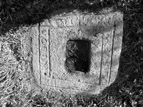
Object type: Cross-base and -shaft
Measurements:
L. 116 cm (46.4 in)
W. 116 cm (46.4 in)
H. c. 48 cm (19 in). Currently part of stone is flush with ground, part stands c. 15 cm (6 in) clear; the larger measurement is based on Iago's record (1878–81, 400)
Mortice: 33 x 47 x 23 cm (13 x 18 x 9 in)
Stone type: A white, glassy, matrix forming about 50% of the rock, is studded with clear quartz crystals ranging in size from 0.2 to 1.0 mm. Most of the quartz crystals have fallen out leaving holes. Pentewan Stone
Plate numbers in printed volume: Ills. 81-2, 350
Corpus volume reference: Vol 11 p. 145-6
(There may be more views or larger images available for this item. Click on the thumbnail image to view.)
The roughly square cross-base contains a rectangular socket-hole. According to Iago (1878–81, 399), this is sunk halfway through the thickness of the stone. Only the upper face of the stone (side E) is now visible.
E (upper): Incised on this, between the edge of the stone and the socket, are two parallel lines, 13 cm apart, forming a frame for the inscription. There is no further decoration. The letters measure 6 to 7 cm in height and are set anti-clockwise around the stone, facing outwards. The text may be complete but is now too highly deteriorated to be sure. The script used was probably predominantly insular. The text reads:

The eighteenth-century drawing mentioned above shows what was probably the text on the lost cross-shaft (see Okasha 1993, 129–32, fig. II.19(ii)). This text appears to have ended:
The text reads: [LU...E–] [CR]VCEM [+–], the only legible word being apparently crucem 'cross'. The text on the lost cross-shaft may have ended with the word nomine 'in the name', but the rest is not now interpretable (see Ill. 350).
Regrettably the inscription is of no help in dating the monument, other than in a general attribution to the pre-Norman period. As the stone is presumably the base of a cross, and Cornish crosses fall between the late ninth and eleventh centuries with most in the tenth and eleventh, this is the date range suggested for the stone.
As an inscribed cross-base this stone is unique in Cornwall unless the Doniert Stone (St Cleer 2) is included, although the latter is a decorated pedestal rather than a base (Ills. 51–5). All other possible early medieval cross-bases are unelaborated, the best example being that supporting Padstow 2 (Ills. 164–8). The shaft with vertically-set inscription which accompanied the St Ewe base has a parallel, however, in Lanteglos by Camelford 1 (Ills. 131–5), although the inscription on the latter is in Middle English, not Latin (p. 165). Cross-shafts with vertically-set inscriptions of this general period can be paralleled in Wales (for example Nash-Williams 1950, 88, nos. 86–7, and figs. on pp. 89 and 94) but not in other parts of England, presumably because this vertical layout reflects that of the earlier inscribed memorial stones of Cornwall and Wales.
St Ewe 1 (Lanhadron) is located beside a road, two miles from the parish church. Other than its roadside location, its context is not clear.
