Select a site alphabetically from the choices shown in the box below. Alternatively, browse sculptural examples using the Forward/Back buttons.
Chapters for this volume, along with copies of original in-text images, are available here.


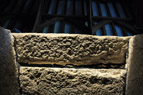
Object type: Part of cross-shaft
Measurements: L./H. 151 cm (59.5 in); W. 43.3 > 36.8 cm (17 > 14.5 in); D. 22 cm (8.6 in)
Stone type: Fine-grained Land's End Granite (A.V.B.)
Plate numbers in printed volume: Ills. 100-2
Corpus volume reference: Vol 11 p. 156
(There may be more views or larger images available for this item. Click on the thumbnail image to view.)
Part of the rectangular shaft of a cross with only two faces visible.
A (broad): The surviving section of the shaft has an incised edge-moulding and is divided into two panels. The upper panel contains an irregular and unidentified six-strand interlace pattern, executed with well-modelled, rounded strands. The lower half of this panel contains rows of holes, either marking out the grid for an unfinished pattern or the result of trimming back the stone for later re-use. In the square lower panel are two concentric circular rings interlaced with two oval rings placed cross-wise (closed circuit pattern B). There is no carving beneath this, either because the shaft is unfinished or because this is the bottom of the shaft. If the latter, which seems most likely since the shaft appears to narrow slightly here, there appears to have been no tenon and the plain lower part of the shaft would have been sunk directly into the ground or into a base.
B (narrow) and C (broad): Not visible
D (narrow): The only decoration visible on this side is a short length of an incised edge-moulding at the top of the fragment and a small portion of unfinished or highly mutilated interlace of uncertain type.
The exclusive use of single-strand interlace in panels distinguishes this cross-shaft from other pre-Norman sculpture in Penwith. Its closest parallels are instead with the crosses of the Panelled Interlace group in east Cornwall (Chapter IX, p. 85). In particular the ring-knot and the use of apparently unusual and irregular interlace can be compared with St Neot 1 (Ills. 151–4). The Doniert Stone (St Cleer 2, Ills. 51–4), arguably the earliest member of this group, is dated to the late ninth century or early tenth century. However a slightly later date is suggested for the St Just shaft because its remoteness, both in Cornwall and from other members of the group, suggests that it may be derivative. Equally, the competence of this piece compared with other pre-Norman sculpture in west Cornwall indicates that it belongs to a different tradition and is likely to be earlier than these.
The existence of this monument in the far west of Cornwall, remote from other members of the Panelled Interlace group, is difficult to explain. The site's early origin is indicated by a place-name in *lann and a sixth- to eighth-century inscribed stone with chi-rho (Okasha 1993, 243–7; Thomas, A. C. 1994, 286–7, 295). In the later medieval period it was believed to have possessed relics of its patron saint (Padel 1988, 100–1; Padel 2002, 355). All these factors may point to an early religious house of local importance in the far west of Cornwall, but do not explain the apparent connection with east Cornwall.
