Select a site alphabetically from the choices shown in the box below. Alternatively, browse sculptural examples using the Forward/Back buttons.
Chapters for this volume, along with copies of original in-text images, are available here.


Object type:
Measurements: H. 215 cm (84.8 in); W. 54 > 35 cm (21.3 > 13.8 in) (shaft); D. 25.5 > 23.5 cm (10 > 9.3 in) (shaft)
Stone type: Coarse-grained granite with feldspar megacrysts up to 6 cm by 1 cm and roughly equidimensional quartz crystals up to 1 cm. Land's End Granite
Plate numbers in printed volume: Ills. 305, 307-11; Colour Pl. 26
Corpus volume reference: Vol 11 p. 239-40
(There may be more views or larger images available for this item. Click on the thumbnail image to view.)
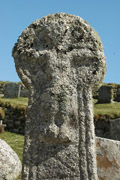
The complete cross stands in a rough granite base, which may be original. It has a simple round head on a shaft of rectangular cross-section which tapers towards the top. A double incised edge-moulding frames the front and back faces of the shaft but on the sides is a single incised line only. A Crucifixion and cross on the head are carved in shallow relief but the decoration of simple zig-zags and crosses on the shaft is incised.
A (broad): There is a single incised edge-moulding around the head, but a double incised edge-moulding extends down the shaft. On the head is an ill-proportioned figure of Christ which stands alone, without any supporting cross. The lower half of the figure extends down on to the shaft. The head is inclined very slightly to the right and has a possible hint of a halo. The arms extend out horizontally to the very edge of the cross-head; they are expanded at the ends, presumably in order to represent the sleeves of a tunic or hands. Beneath the constricted waist is a slightly raised horizontal band, probably a belt, and the knee-length garment is unusually full. The legs are slightly apart and the feet, which are shown projecting forwards, rest on a small ledge. The incised decoration immediately below the figure comprises two diagonal crosses within squares followed by a double diagonal cross within a square. A pendant semi-circle below this, shown by Langdon, is not now clear (Langdon, Arthur 1896, 299 and fig.).
B (narrow): The single incised edge-moulding is the only elaboration on the head. At the top of the shaft are two roughly parallel vertical incised lines. Two-thirds of the way down the shaft they begin to zig-zag in opposite directions to make a row of six vertically placed diamond shapes. The carving fades out towards the bottom of the shaft.
C (broad): A double incised edge-moulding extends around most of the cross-shaft and head; but the inner line is not detectable around the top half of the head and it fades just before the bottom of the shaft. On the head is a relief-carved cross, type A2, with a long shaft which runs all the way down the cross-shaft, gradually widening towards the bottom. It stands on an incised triangular pedestal which is joined by two horizontal lines to the incised edge-moulding.
D (narrow): The single incised edge-moulding is the only decoration on the head. On the shaft, a crudely incised shape at the top may be a rough figure, a sword, or a cross in outline with raised arms. Below this, a simple incised zig-zag fills the rest of the shaft.
Appendix D item (continuing tradition)
This cross is competent and assured. The design is well-proportioned and the figure and carved cross well executed; compared with this, the incised decoration seems rather crude.
Although, in common with the Penwith group of pre-Norman sculpture (p. 88), the cross has a Crucifixion figure on one side of the head, in all other respects it is different, and represents a later piece of work. The round head is typical of medieval Cornish wayside crosses; the closest parallel for the incised work is Sancreed 2 (Ills. 316–19), but other examples exist amongst continuing tradition crosses of the Carnmenellis granite area, for example Camborne 4 (from Fenton-Ia, Ills. 291–3) and Wendron 5 (from Nine Maidens Down, Ills. 334–6). The Crucifixion (Ill. 305) is typical of Romanesque representations with arms outstretched, head slightly inclined to the right, feet side by side, sometimes on a suppedaneum, and a knee-length loin-cloth (see the illustrations in Ó Floinn 1987, 168–88), and the zig-zags and diamonds are also reminiscent of Romanesque work. The form of the carved cross on St Levan 1 is unusual on Cornish crosses. The only other example in Cornwall is on the churchyard wall at St Levan, a late example of a wayside cross, with a chamfered shaft, presumably copied from this cross. Its greatest resemblance is to a medieval processional cross, and the triangular base of the long-shafted cross is similar to the stylised hills of calvary seen on some medieval (twelfth- to sixteenth-century) grave-slabs.
The cross is assumed to be in situ, on the east side of the south entrance to St Levan church. Set in the bottom of a small remote valley close to the coast; with a Celtic dedication and a small curvilinear churchyard, St Levan is likely to be a site of early medieval origin, although there is no place name in *lann or monumental evidence to support this. It is a chapelry of St Buryan, whose early medieval land-owning church retained collegiate status and enjoyed particular privileges throughout the medieval period. The cross can possibly be attributed to its relationship with this locally important mother church.
