Select a site alphabetically from the choices shown in the box below. Alternatively, browse sculptural examples using the Forward/Back buttons.
Chapters for this volume, along with copies of original in-text images, are available here.


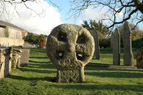
Object type: Cross-head and part of -shaft
Measurements: H. 108 cm (42.5 in); W. 82 cm (32.3 in) (head), 49 > 46 cm (19.3 > 18.2 in) (shaft); D. 27 cm (10.6 in) (head), 28 cm (11 in) (shaft)
Stone type: Coarse-grained, slightly micaceous, poorly megacrystic, granite. White feldspar, with scattered megacrysts up to 3 cm by 0.5 cm, and roughly equi-dimensional clear quartz up to 4 mm across occur in roughly equal proportions and form the bulk of the rock. A few flakes of white mica up to 3 mm across, and tourmaline intergrown with the quartz form less than 1% of the rock. Bodmin Moor Granite
Plate numbers in printed volume: Ills. 145-8; Fig. 18K
Corpus volume reference: Vol 11 p. 170-1
(There may be more views or larger images available for this item. Click on the thumbnail image to view.)
Head and part of the shaft of a cross of rectangular section, set in a modern base. As Langdon notes (Langdon, Arthur 1896, 385), the head is massive; the original monument would have been substantial. On the head the three upper limbs of the cross are a variant of type A3, with large, asymmetrical, wedge-shaped terminals with curved outer edges; the lower limb splays slightly and has a broad half-round terminal. The ring, type (b), is recessed from the face of the cross. The four segments between the cross-arms and the ring are deeply hollowed out, but in each only a small hole has been completely cut through.
A (broad): At the centre of the cross-head is a prominent boss, encircled by an incised line. The shaft has a neatly cut roll-moulding but within this, the decoration shown by Langdon (1896, 385) cannot be made out, apart from a few faint hollows.
B (narrow): A broad, raised, flat band runs over the ends of the cross-arms and the ring; within this, there are traces of an incised edge-moulding. The angles of the shaft have a shallow roll-moulding, with traces of interlace within; but the detail of the interlace shown by Langdon can no longer be made out.
C (broad): The head has no central boss and is plain except for traces of an incised edge-moulding. The shaft has a shallow roll-moulding down the sides but no other decoration is visible: within the edge-moulding, the shaft is smooth and may never have been carved, suggesting perhaps that the cross is unfinished.
D (narrow): A broad, raised, flat band runs over the ends of the cross-arms and the ring; within this, there is an incised edge-moulding. The shaft has a roll-moulding on the angles but no other decoration is visible.
This form of cross-head, with straight arms and large, wedge-shaped terminals, is unique in Cornwall and cannot be easily paralleled. Many Irish crosses have arms with square terminals but these are invariably set at the ends of curving arm pits and extend beyond the edge of the ring. A similar form is ubiquitous on the Isle of Man also, with one example at Michael having more wedge-shaped terminals (Kermode 1907, 165–7, pl. XL). Wales has a variety of cross-head forms but even here, close parallels are hard to find. At Margam on the south Welsh coast is a group of disc-headed crosses with expanded arm-terminals and of these, Margam 4's terminals are wedge-shaped while Margam 2's arms are straight (though extending from a square centre) (Redknap and Lewis 2007, 408–27; see also 456–9). St Minver 1 (Porthilly) in fact appears to be a hybrid, combining the typical Cornish curved arm-ends and central boss with the straight arms and square or wedge-shaped terminals found in Wales.[1]
The Welsh parallels are of interest given the coastal location of both sites. The eccentricity of the Porthilly cross compared to other monuments in the county can also be compared with the cross at Plymstock, Devon (Cramp 2006, 87–9, ills. 34–8), which likewise has expanded, wedge-shaped terminals and an estuarine location, although here the similarity ends.
It has been suggested that this head may have been connected with the cross-shaft in Padstow churchyard (Padstow 2, Ills. 164–8), although this seems unlikely as the two monuments are of different style and, although both are of Bodmin Moor granite, have slightly differing geology. However its original size may have been comparable to Padstow 2 and 3: at 83 cm across, Porthilly's head is close in size to that of Padstow 3 (p. 178, Ills. 169–72) and an original height of over three metres may be indicated.
St Michael Porthilly is, with the similar site at St Enodoc, a chapel-of-ease to St Minver, in the lowland part of St Minver parish. Both St Michael and St Enodoc are set on the edge of the wide estuary of the River Camel, opposite Padstow, with tidal waters lapping the churchyard wall at St Michael. For this reason, an early medieval origin seems probable for both, although there is no confirmatory place-name in lann for either site. At St Enodoc, settlement and burial remains of the Romano-British and early medieval periods have been found close to the church (Polsue 1870, 370; Maclean 1879, 6–8; Historic Buildings and Monuments Record 26348) and recent discoveries at St Michael hint at the same (Gossip 2010, 11–13). Despite this potential early medieval origin, the existence of a substantial cross at the chapel of St Michael seems unusual since most early sculpture is found at sites with full parochial status or (as in the case of Gwinear 1, p. 152) at a chapel site, associated with a significant manor. St Michael Porthilly has no significant manorial association. It might once have had greater status, but if so this must have been lost to the mother church of St Minver during parochial reorganisation in the Norman period. The possibility that it was once more important is increased by the fact that both St Michael and St Enodoc retain fonts and burial rights, despite their dependence on St Minver. On the other hand, an early association with St Petroc's monastery is also possible for not only is Padstow a short distance across the water from St Michael, but in the Middle Ages, the parish as a whole was in the gift of the Priors of Bodmin (Maclean 1879, 12–14).
As the cross is without parallel in Cornwall, and does not have any definitely datable features, a wide date-range is suggested.
