Select a site alphabetically from the choices shown in the box below. Alternatively, browse sculptural examples using the Forward/Back buttons.
Chapters for this volume, along with copies of original in-text images, are available here.


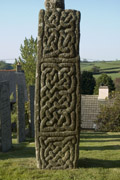
Object type: Cross-shaft
Measurements: H. 198 cm (78 in); W. 56 > 51 cm (22 > 20 in); D. 39 cm (15.5 in)
Stone type: Medium-grained, slightly micaceous, poorly megacrystic, granite. A few scattered feldspars up to 2.5 cm x 0.6 cm occur. Quartz crystals mostly equidimensional up to 1.0 cm; a few small flakes of white mica up to 1.0 mm across. Bodmin Moor Granite
Plate numbers in printed volume: Ills. 151-4; Colour Pl. 30
Corpus volume reference: Vol 11 p. 171-2
(There may be more views or larger images available for this item. Click on the thumbnail image to view.)
Part of a cross-shaft of almost square section, with a marked entasis, set in a base, although the base is currently invisible beneath the turf. Each face of the shaft has a flat edge-moulding and a similar band divides each face into three panels. The decoration within the panels consists of interlace and knotwork, neatly constructed in rounded strands, although in detail the patterning is irregular and asymmetrical.
A (broad): The upper panel consists of closed circuit pattern A (ring twist). The middle panel contains an asymmetrical panel of eight-cord interlace including a pattern F loop with outside strand, in which the pattern has been completed by inserting a closed circuit loop at the top left corner and also an added diagonal strand from the top right to the bottom left. The square bottom panel has a knot with two rings interlaced by two diagonal strands (closed circuit pattern B).
B (narrow): The upper panel of interlace contains a six-cord plait and the middle panel contains a knot developed from a six-cord plait (half pattern B with outside strands). The lower panel has irregular six-cord interlace with two extra elliptical rings at the upper corners (possibly closed circuit pattern C).
C (broad): Three panels of asymmetrical and irregular eight-strand interlace. The central panel appears to be based on half pattern F with outside strands.
D (narrow): All three panels contain a regular eight-cord plait.
As noted by Langdon, 'this is the best example of interlaced work on a cross in Cornwall'. Although the interlace is not perfect, in that it is irregular and includes closed rings to help complete the patterns, the patterns are nonetheless well designed and well executed on a grid, and 'as proof of the superiority of workmanship of this stone compared with others ... all the interlaced cords lap regularly over and under each other' (Langdon, Arthur 1896, 406). Indeed, the whole design and layout of the shaft reflects this competence.
The cross is a member of the Panelled Interlace group of crosses (Chapter IX, p. 85). Another member of the group, the Doniert Stone (St Cleer 2, Ills. 51–5) can, with a certain degree of confidence, be dated to the late ninth century on the grounds of its inscription; a similar date seems likely for St Neot 1. The elements in the design noted above, like the insertion of rings and the use of ring-twist, would normally be ascribed a 'Viking Age' date elsewhere and assigned an early tenth-century date at the earliest (Bailey 1980, 72). However the competence of the piece and the historic associations of the site, which point to a potential context for the sculpture in the time of Alfred, are accepted here as supporting a late ninth- or very early tenth-century date.
The evidence for St Neot as an early monastery has been assembled by Olson (1989, 85–6, 89, 105). It possessed relics of two saints, Gueriir and Niot and it was here, while hunting in Cornwall as a young man, that Alfred is said to have been cured after praying at St Gueriir's shrine (Padel 2002, 324). The date of this event (pre-870) is probably too early for the cross to be directly associated with Alfred's visit, but it may perhaps be seen as the result of continued benevolence associated with this monarch. The saint is probably included in the tenth-century List of Cornish saints (Olson and Padel 1986, 49–51) and in 1086 the clerici Sancti Neoti are recorded as holding the manor of Neotestou, but with the ominous note that the 'Count has taken all this land away from the Church, except for 1 acre of land, which the priests have' (Thorn and Thorn 1979, 4,28). The community is not recorded again.
