Select a site alphabetically from the choices shown in the box below. Alternatively, browse sculptural examples using the Forward/Back buttons.
Chapters for this volume, along with copies of original in-text images, are available here.


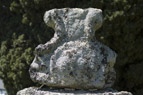
Object type: Cross-head fragment
Measurements: H. 38 cm (15 in); W. 35.5 cm (14.5 in); D. 21.5 cm (8.5 in)
Stone type: Medium-grained, slightly micaceous, poorly megacrystic, granite. A few scattered feldspars up to 2.5 cm x 0.6 mm occur. Quartz crystals mostly equidimensional up to 1.0 cm; a few small flakes of white mica up to 1.0 mm across. Bodmin Moor Granite
Plate numbers in printed volume: Ills. 149-50; Colour Pl. 30
Corpus volume reference: Vol 11 p. 173
(There may be more views or larger images available for this item. Click on the thumbnail image to view.)
Small section of a cross-head of rectangular section. The fragment consists of the central area of the head, with the stumps of three arms attached. The arm-pits are rounded and on the longest arm are roll- mouldings representing the cusps of a trefoil-holed cross. Beyond this point the arm is broken and there are no traces of the cross-ring.
A (broad): An incised edge-moulding encloses the decoration on the head. A large boss surrounded by a flat moulding occupies the whole of the centre of the head. On each of the stumps of the arms are the remains of a triquetra knot, executed in low relief.
B and D (narrow): Broken
C (broad): Like face A, this side has a large central boss with concentric moulding and traces of knotwork in the arms. However on this face, the largest surviving section of arm appears to contain two back-to-back Stafford Knots (simple pattern E) while the other two have probable triquetra knots.
This fragment was at first believed to have been part of the head of St Neot 1 (Henderson, C. 1929c, 47) and this view has been followed since (see for example Ellis, G. 1962–4b, 35–6). However the very different cross-sections and styles of the two stones suggest that St Neot 2 is part of a separate monument. St Neot 1 is thick with a square cross-section while St Neot 2 is much thinner and has a rectangular section. The decoration on St Neot 2 is carved in much shallower relief than that on St Neot 1. While St Neot 1 is probably to be dated to the late ninth or early tenth century, the presence of cusps on St Neot 2 indicates that this is one of the small but dispersed group of crosses found in Mid and East Cornwall, characterised primarily by the trefoil openings in the head (Chapter IX, p. 92). As well as the cusps, other features shared with these crosses are the very narrow rectangular cross-section, the large central boss with surrounding moulding, the low relief carving and the triquetra knots in the arms. The St Columb Major 1 head is the only other example with Stafford Knots, these being on one side of the head, in one of the horizontal arms only (Ill. 62). As only a small fragment of St Neot 2 remains, the piece is dated in line with other examples of trefoil-holed crosses.
The context of the St Neot's sculpture is discussed under St Neot 1 (p. 172). This fragment is of interest in representing continued activity at a site which had been of significance in the time of King Alfred, but was on the brink of extinction in 1086.
