Select a site alphabetically from the choices shown in the box below. Alternatively, browse sculptural examples using the Forward/Back buttons.
Chapters for this volume, along with copies of original in-text images, are available here.


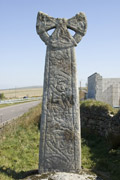
Object type: Cross-shaft and part of -head
Measurements: H. 276 cm (108.5 in); W. 87.5 cm (34.5 in) (head), 72 > 49 cm (28.5 > 19.3 in) (shaft); D. 15.5 cm (6.3 in) (head), 19.5 > 18 cm (7.5 > 7.3 in) (shaft)
Stone type: Fine-grained Bodmin Moor granite, type 1c (A.V.B.)
Plate numbers in printed volume: Ills. 155-8; Colour Pl. 31-32; Figs. 17e, 18f, 20i-j, 20o
Corpus volume reference: Vol 11 p. 174-5
(There may be more views or larger images available for this item. Click on the thumbnail image to view.)
Part of the head and shaft of a cross of rectangular section, overall a large impressive monument of good proportion and competent design. The tapering shaft has a slight entasis and is very narrow in relation to its width. The cross-head, type E8, stands slightly forward in relief from the shaft; it has widely-splayed arms with angular arm-pits and a slightly recessed ring, type b. The convex curved end of the bottom arm is slightly wider than the top of the shaft. A broad incised edge-moulding frames the decoration on the shaft and presumably the head too, although the latter is too worn for it to be made out clearly. The decoration, which is both incised and in low relief, is notable for its uncluttered layout.
A (broad): At the centre of the cross-head is a small boss. According to Langdon, this was surrounded by an incised moulding (Langdon, Arthur 1896, 387); however this is not now visible. A triquetra knot is carved in low relief in each of the three surviving arms. Incised on the shaft is a large, relaxed plant trail characterised by lush curling acanthus-type leaves and a ridge or band across the plant stem, not at the node but at the point where the main stem touches the edge-moulding. The modern letters G, L and W, deeply incised halfway down the shaft, make interpretation of the design in this area difficult.
B (narrow): The cross-head is plain. On the shaft is a continuous panel containing simple pattern F, the Carrick Bend, the individual knots separated by glides. The O.S. bench mark has been incised near the bottom of the shaft.
C (broad): This is more worn than face A, particularly in the top half, where only slight traces of the pattern now remain. The cross-head contains a small central boss but otherwise only faint traces of decoration are visible. In the lower half of the shaft, arising from a stepped base above a plain panel, is an acanthine tree-scroll of two registers. It is possible that the plain panel was designed to hold an inscription. The two separate central stalks are bound by a band at the point from which the fleshy curling leaves fall outwards. In the upper part of the shaft, the decoration is too worn for it to be deciphered clearly, but from the faint traces there appear to have been two further registers of double plant-scroll, similar to those in the lower part of the shaft. These were separated from the lower plant decoration by a worn panel which contained some decoration or possibly inscription, now too deteriorated to make out.
D (narrow): The cross-head is plain. On the shaft is a relief-carved plant trail, with fleshy, curling acanthus-type leaves in the volutes.
The fleshy acanthus leaves used for the plant trails and scrolls on three faces of this cross appear to be related to the early phases of the Winchester school, as seen in an illustration at the beginning of Bede's Life of St Cuthbert (Cambridge, Corpus Christi College, MS 183, fol. 1v, conveniently available at:
The patterns and form of this cross had a far-reaching influence on the design of later crosses in the area: acanthine plant trails feature prominently on crosses of the Mid and East Cornwall group from Padstow to Quethiock in south-east Cornwall (see p. 91, Ills. 172, 208, 210).
The cross stands beside the A30 on formerly open downland at the heart of Bodmin Moor. Here it is also close to the boundary between the parishes of St Neot and Blisland and between the hundreds of Trigg and West Wivelshire. It is therefore in a significant and prominent location, on what is nowadays the main land-route into Cornwall. Turner suggests that this cross marked a boundary of lands associated with St Neot's church (Turner 2006c, 37–9).
The status of this route over Bodmin Moor is uncertain, given that St Cleer 2 and 3 and Warleggan 1, as well as St Neot 1 and 2 and Cardinham 1 appear to be indicating the primacy of a route along the southern edge of the moor. Perhaps, however, St Neot 3 indicates greater use of the A30 route as English dominance in Cornwall increased and St Petroc's, based at Padstow and Bodmin, rose to prominence in the later tenth and eleventh centuries. Its positioning here might also be associated with an extension of settlement onto the moor towards the end of the early medieval period. Permanent settlement had been established in the moorland parish of St Breward before the Norman Conquest (Johnson, Rose et al. 2008, 77–80) and environmental evidence from excavations in advance of the flooding of Colliford Reservoir suggests a clearance of wood and scrub, extension of pasture and intermittent cereal cultivation possibly (but not certainly) linked with tin-streaming in the upland parts of St Neot parish at about the turn of the first millennium (Austin, Gerrard, Greeves et al. 1989, 225). St Lukes, a chapel-of-ease located in the upper reaches of the Fowey Valley, on the eastern edge of St Neot parish, is likely to have been established by the eleventh century to serve a population colonising the higher parts of the Bodmin Moor at this time (Johnson, Rose et al. 2008, 79).
