Select a site alphabetically from the choices shown in the box below. Alternatively, browse sculptural examples using the Forward/Back buttons.
Chapters for this volume, along with copies of original in-text images, are available here.


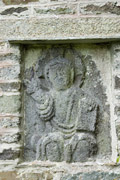
Object type: Architectural sculpture
Measurements: H. 71 cm (28 in); W. 51 cm (20 in); D. Uncertain
Stone type: Greyish red (5R 4/2), vesicular, tufaceous, fine-grained agglomerate with scattered small (1 cm by 2 cm) clasts of siltstone. Tintagel Volcanic Formation. The lithology of St Stephen by Launceston 2 is essentially the same. Both pieces, and the many similar stones built into the east wall of the chancel, probably have a local source either from the outcrop forming the ridge west of Launceston (SX 298 842 to 337 847) or from the outlier at Truscott (SX 300 855) where there used to be a quarry for roadstone.
Plate numbers in printed volume: Ill. 269
Corpus volume reference: Vol 11 p. 219-21
(There may be more views or larger images available for this item. Click on the thumbnail image to view.)
Although set in a rectangular recess built into the wall of the church, the sculptured panel has a rounded top, like St Stephen by Launceston 2, suggesting that this may be its original shape. It contains a seated figure of Christ in Majesty. He is shown forward-facing with the right hand raised in blessing, thumb and first two fingers extended, and the left hand holding a book, which rests on his knee. The cushion and back of a seat or throne is indicated on the right-hand side of the body. Encircling Christ's head, which leans slightly to the right, is a large, dished, cruciform halo. His hair is depicted as a ring of curls around his head but with longer hair falling behind his shoulders. His facial features are not indicated, other than a possible trace of a nose and mouth. The shape of the chin suggests only a small beard, if any. Christ wears a long-sleeved, knee-length robe, falling in folds from his raised right arm, above his lap, and over his knees, with a large pleat or a girdle hanging down between his legs. The edge of his robe and a narrow sash (or perhaps a fold of the garment) can be seen falling across his left shoulder. It is probable that the bottom of the panel has been trimmed, for Christ's legs end just below the knees, and the fact that this panel is slightly shorter that St Stephen 2 confirms this, as the two were probably both part of the same decorative scheme.
Appendix A item (stones of uncertain date)
The two sculptures at St Stephen's have never received much consideration or illustration either within Cornwall or outside. The few authorities that mention them, for example Sedding and Pevsner (Sedding 1909, 367; Pevsner 1970, 201) consider them Norman, although without discussion of the reasons for that conclusion. In fact, it is equally possible that they are of pre-Norman origin. Perhaps the absence of notice is because the stones are unparalleled, not only in Cornwall, but also in Devon. In fact, the nearest examples of such figure carving are the remains of two early eleventh-century architectural panels in Somerset, at Congresbury and Langridge, although neither is an exact parallel for the two St Stephen's stones (Cramp 2006, respectively 149–51, ills. 204–20; 169–70, ill. 305).
The first panel at St Stephen's is very much better preserved than the second, with features like the individual fingers and the folds of the garment very clearly visible. This raises the question of why so little detail is visible on the face, and perhaps indicates that, as is suggested below for the second slab, the panels were painted. It might also, as will emerge below, suggest use of a very simple model.
Christ in Majesty is an enduring image in Christian art. So, although details may vary, parallels for both the overall composition and individual details can be found in both pre- and post-Conquest contexts, in many different media. The St Stephen's Christ is simple in its rendering, but not quite as crude as some. For example, while St Stephen's 1 is nowhere near as simple as the Christ in Majesty at Daglingworth, Gloucestershire (Bryant 2012, ills. 103–4), it looks unsophisticated compared to the peaceful and meditative image at Barnack, formerly Northamptonshire, now Cambridgeshire
Disregarding the more undiagnostic features like the cruciform halo or the book supported on the knee, the element which stands out in the St Stephen's image is the nature of the garment worn by Christ which, with its almost rope-like folds and the way that it falls over Christ's knees (rather than covering them) appears very distinctive. Despite its greater sophistication, Barnack's Christ in Majesty can be compared. The fall of the delicately modelled folds of Christ's garment to either side of and between his bare knees is especially comparable. Suggested dates for this composition vary, between the late tenth and twelfth century, with a concentration in the first half of the eleventh century and a tendency to evoke French influence in its design
However the best parallels for the manner in which the folds of the garments are depicted at St Stephen's are small simple artefacts, like the small copper-alloy reliquary from Sandford-on-Thames (Zarnecki et al. 1984, 239, ill. 228) or a bone plaque from Leckhampstead (Williamson 2010, 254–5, cat. 65). On the latter, even though there are differences in detail (the head is turned, the robe is full length), the fall of the robe over the shoulder, from the right arm, at the waist and between the legs, is very similar. This plaque has been dated to the first half of the eleventh century. The simple method of showing the drapery in this example must be attributable to its very small size (just 5 cm/2 in high), and the suggestion arising from this is that the sculptor of the St Stephen's figure perhaps used a similarly small artefact to help lay out his design. On the other hand, the drapery clothing the figures on the font at Orleton, Gloucestershire, considered a rustic example of the Gloucestershire Romanesque, is also remarkably similar (Thurlby 1999, 157, fig. 243).
There are no parallels for this sculpture in either pre- or post-Conquest Cornwall. Pre-Norman figure sculpture is restricted to the images of the Crucifixion of the Penwith group, which may owe their origin to Irish models, and to a few very simple incised figures, the best of which is a possible figure of St Peter on the cross-shaft Lanivet 2 in mid Cornwall (see Chapter VII, p. 78, and Ill. 119). Both St Stephen's 1 and 2 were presumably intended to elaborate and decorate a church. But there is no extant pre-Norman architecture known in Cornwall and no parallel in Cornish Romanesque work. Lively animals feature on several Norman tympana in Cornwall, for example at Egloskerry in the Launceston area, and a good number of Norman fonts have heads at their corners and sculptured creatures, the best example being at Bodmin (Sedding 1909, pls. IX, X, XXXVIII, XXXIX). There are, however, no surviving examples of figure carving.[1]
With no helpful Cornish parallels and a wide range of dates centring on the eleventh century for the non-Cornish parallels mentioned above, it remains uncertain whether this Cornish Christ in Majesty should be dated pre- or post-Norman Conquest. It remains to examine the context in the hope of gaining further insight.
Although the name of Launceston now applies to the town to the south of St Stephen's church, it originally applied to St Stephen's, to be transferred to the present town in Norman times after the establishment of the castle and town (Orme 2010, 201). The name of Launceston, originally Lann-Stefan, 'church-site of St Stephen' implies a site of early medieval origin (Padel 1988, 158). Here was a land-holding church held in 1066 by the canons of St Stephen, whose property suggests that it was of equal rank to that at Bodmin (Orme 2010, 132, 201–4). It was almost certainly owned by a body of canons in pre-Norman times and Orme considers that St Stephens was equivalent to an important English minster church (Orme 2010, 202, 132). Located close to one of the main crossing points of the River Tamar, St Stephen by Launceston was also an important Anglo-Saxon commercial and administrative centre, with a market in existence before Domesday Book (Thorn and Thorn 1979, 4,2) and a mint (the only mint in Cornwall) issuing coins from the reign of Aethelred II to Henry II (that is, from c. 1000 to the second half of the twelfth century) (Penhallurick 2009, 13–16). After the Norman Conquest, the church and manor came under the protection and endowment of Robert, Count of Mortain, chief landholder in late eleventh-century Cornwall and builder of Launceston Castle, which was already in existence in 1086 (Thorn and Thorn 1979, 5,1,22; Orme 2010, 201). Augustinian rule was established by William Warelwast, Bishop of Exeter, in 1127 after which, by 1135, the move to a new site in the valley to the south had begun (Orme 2010, 203).
Under the patronage of the Count of Mortain, St Stephen's church underwent rebuilding in the late eleventh or early twelfth centuries. There is literary evidence for the building of a large tower in about 1106 which was then destroyed in c. 1140 (Orme 2010, 203). Remnants of this church of the late eleventh or early twelfth centuries indicate a substantial building with an elaborate east end, in keeping with its status as the church of a significant collegiate church endowed by the most powerful baron in Cornwall. The font, with cable mouldings and plant trail, considered by Sedding to be 'one of the most valuable of our early Norman examples' (Sedding 1909, 364, pl. CXLIV) but by Berry (n.d., 42) to be late Norman, may represent a further example of carving associated with this important church. The church was re-dedicated in 1259, but Berry (n.d., 39) finds no architecture of that date in the church, whose modern plan is considered to reflect, to this day, that of the early Norman building. At present, therefore, the late eleventh or early twelfth century seems the most probable context for the sculptures described here, although, since St Stephen's was the site of a pre-Norman collegiate church, town and mint, there must also have been a significant pre-Norman church. The fact that the sculptures were not in situ when the church was restored in 1883, but are said by Peter to have been found in the walls of the sacristy and chancel, may point to their re-use in the Norman building; however, as the church is also known to have been restored in 1698, there is an alternative occasion on which they could have been taken down and recycled as building stone (Peter, O. 1906, 27). However further evidence discussed below under St Stephen's 2 may confirm their inclusion within the Norman structure. In either case it is likely that both sculptures were designed to embellish the east end of the church, since this is where they were found.
