Select a site alphabetically from the choices shown in the box below. Alternatively, browse sculptural examples using the Forward/Back buttons.
Chapters for this volume, along with copies of original in-text images, are available here.


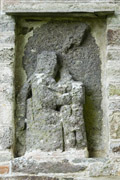
Object type: Architectural sculpture
Measurements: H. 89 cm (35 in); W. 56 cm (22 in); D. Uncertain
Stone type: Greyish red (5R 4/2), vesicular, tufaceous, fine-grained agglomerate with scattered small (1 cm by 2 cm) clasts of siltstone. Tintagel Volcanic Formation. See comments under St Stephen by Launceston 1, stone type.
Plate numbers in printed volume: Ill. 270
Corpus volume reference: Vol 11 p. 222-3
(There may be more views or larger images available for this item. Click on the thumbnail image to view.)
Like St Stephen by Launceston 1, the sculptured panel has a rounded top, suggesting that this may be its original shape. It contains low-relief carvings of the Virgin and Child. The panel is highly eroded and has been defaced, with Christ's head being removed. Mary is seated sideways on a simple chair; no details of her clothes survive (or perhaps were ever carved) apart from a long veil or head-dress hanging down behind her chair. On top of Mary's head is a feature which might be a band holding the veil, but as the sculpture is damaged here it is difficult to be sure. There is no trace of a halo. Mary's sleeved right arm holds the Child and her legs are hidden by the Child, who sits on her lap. Though sadly mutilated, so that very little survives of the head and no halo is evident, Christ is clearly forward facing, leaning in slightly towards his mother. He wears a long, sleeved robe, the hem just above his two pointed feet. Christ's right hand is raised, presumably in blessing, although the individual fingers cannot be seen, while his left hand, which cannot be made out, presumably holds the book which is resting on his left knee. On the right, above the two figures, the Hand of God extends down in blessing.
Appendix A item (stones of uncertain date)
Like St Stephen by Launceston 1, it is likely that this panel formed part of a decorative scheme at the east end of the church. It is very simple, with little detail and has been mutilated with the removal of Christ's face.
The panel is remarkably similar in its composition to the carving of the Virgin and Child at Inglesham, Wiltshire (Cramp 2006, 217–19, ill. 453). This also depicts Mary on the left, facing towards the Child who is seated on her knee and leans in to her body. More detail is visible on Inglesham, because it is better preserved, although it has been suggested that the absence of some elements, for example of drapery folds, Mary's halo, or facial features, may be explained by the fact that it was originally painted. Similarly, Bryant points out that the face of the Virgin Mary in the Virgin and Child panel at Deerhurst in Gloucestershire is a flat oval that was almost certainly painted (Bryant 2012, 170–2, ills. 147–8), and this must also be a possibility for St Stephen's 2. The suggestion has also been made above that St Stephen's 1 used a very small simple model, like an ivory or metal plaque. Compared to Inglesham, however, which has itself been sometimes seen as a crude example of local work (Cramp 2006, 219), the St Stephen's carving appears even more rustic, the figures rather 'boxy' and wooden, with Christ in particular appearing truncated on the right, although this may well be the effect of later mutilation.
The Inglesham slab has been dated widely, with dates suggested varying from the tenth to twelfth centuries (Okasha 1971, 82; Cramp 2006, 219). For St Stephen's 2 a similarly wide date range may be possible, although it is likely to have been contemporary with St Stephen's 1, for which a preference has been proposed for the late eleventh century, to coincide with the early Norman rebuilding of the collegiate church.
Some support for the fact that the sculptures may have been a feature of the early Norman, rather than the pre-Norman church, may come from the later history of St Stephen's 2. The mutilation of the figure of Christ is most likely to have been iconoclasm associated with the Commonwealth, so of the seventeenth century. For this to have occurred, the slab must have been on display at this period, then subsequently incorporated as building stone into the wall from which it was rescued in the late nineteenth century (perhaps during the 1698 restoration mentioned in the discussion of St Stephen's 1). As the east end of the church still contains Norman work it is therefore probable that the Norman structure was the context for the sculptures.
The history of the site and the possible context for this carving is discussed above under St Stephen by Launceston 1.
