Select a site alphabetically from the choices shown in the box below. Alternatively, browse sculptural examples using the Forward/Back buttons.
Chapters for this volume, along with copies of original in-text images, are available here.


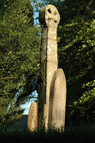
Object type: Cross-shaft and -head
Measurements: H. 396 cm (158.4 in); W. 58 cm (23.2 in) (head), 53 > 32 cm (21.2 > 12.8 in) (shaft); D. 36 > c. 20 cm (14.4 > 8 in)
Stone type: Yellowish grey (5Y 7/2), medium grained, slightly micaceous granite. White feldspars megacrysts up to 18 mm form about 25% of the rock; roughly equidimensional clear and milky quartz phenocrysts and a few scattered flakes of white mica are set in a fine-grained matrix. Bodmin Moor Granite
Plate numbers in printed volume: Ills. 218-23; Figs. 20C, 20L
Corpus volume reference: Vol 11 p. 200-1
(There may be more views or larger images available for this item. Click on the thumbnail image to view.)
Head and shaft of a highly mutilated but reconstructed rectangular-section cross. The cross-head, type E8, is of slightly oval shape, being taller than it is wide. The arms are linked by a ring, type a. A shallow roll-moulding encloses the decoration on both head and shaft. All decoration, where it survives, is in very low relief.
A (broad): Within the edge-moulding in the cross-arms are indistinct remains of triquetra knots, and a small low central boss. On the top third of the shaft and on the right-hand side of the lower two-thirds are the remains of interlace.
B (narrow): On the end of the broken cross-arm are traces of what might have been two interlaced ovals. On the side (top only) are the remains of a type of tree-scroll.
C (broad): Traces of edge-mouldings only are visible. No other decoration survives.
D (narrow): The cross-arm on this side has been rebuilt. On the top part of the shaft is a spiral scroll with small simple leaves in the spaces between the plant stem and the edge-moulding.
Langdon suggests that the decoration was deliberately removed in 1841 when the lower part of the shaft was used for the coping of the wall (Langdon, Arthur 1896, 392–3), and that that which does survive is generally too worn to interpret and discuss in detail. However, the spiral plant-scroll and the very low-relief carving allies it with the Mid and East Cornwall sculpture group (Chapter IX, p. 91). In term of overall design (great height, elegant proportions, elliptical head), its closest parallel is the cross at Quethiock, another member of the group, although the latter has a trefoil-holed head (p. 196, Ills. 206–11). The tree-scroll is unique in Cornwall, but may be related to the double acanthus scroll on St Neot 3, face C (Ill. 157); or that on Littleton Drew 1bC in Wiltshire (Cramp 2006, 53, 221–2, fig. 22 (n), ill. 455). These parallels suggest that, although it is defaced and has no interlace patterns, St Teath should be included with the Mid and East Cornwall group, and similarly dated.
St Teath church takes is named from its Celtic patron saint; a name in eglos- is recorded once (Padel 1988, 162). The churchyard enclosure is large and oval, but given the upland location of the site, this may be because it is based on a prehistoric settlement enclosure (Preston-Jones 1994, 83, fig. 6). Cists have been found here, outside the churchyard (Preston-Jones 1984, 177). Henderson notes that 'In the 13th century this church was collegiate...but there is no record of a collegiate character before the Conquest. The Norman church here had aisles which would suggest that the college was then established' (Henderson, C. 1925, 201). Orme confirms that 'when and how the prebends originated is unknown' (Orme 2010, 271).
