Select a site alphabetically from the choices shown in the box below. Alternatively, browse sculptural examples using the Forward/Back buttons.
Chapters for this volume, along with copies of original in-text images, are available here.


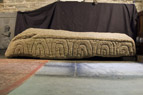
Object type: Coped stone
Measurements: L. 218 cm (82 in); W. 46 > 32 cm (18.2 > 12.6 in); H. 49 > 38 cm (19.3 > 15 in)
Stone type: Coarse-grained, megacrystic, granite. Feldspar megacrysts up to 1.5 cm by 3 mm are intergrown with quartz; some discrete, equidimensional quartz up to 6 mm across occurs, together with a few flakes of white mica up to 2 mm across and needle-shaped tourmaline. Bodmin Moor Granite
Plate numbers in printed volume: Ills. 229-33; Fig. 20n
Corpus volume reference: Vol 11 p. 203-4
(There may be more views or larger images available for this item. Click on the thumbnail image to view.)
Grave-cover, type g. The stone has a house-shaped cross-section and wedge-shaped plan, being wider at one end (C) than the other (E). The base of the stone appears to be uneven and the pattern is unfinished at the bottom. This suggests that the stone may be broken.
A (top): The ridge is plain and runs into a wide flat band which continues around both sides and both ends. The sloping portion above face B consists of a simple spiral plant-scroll. The sloping portion above face D contains a simple twist at the narrow end which develops into a plait. The triangular sloping portion above face C contains a triquetra knot, but that above face E is plain.
B (long): The lower sloping portion beneath the band contains rounded arcading, each arcade formed by two bands set one within the other. Between the arcades are plant stalks which divide at the top to form simple foliage, with a small bud between each of the two branches.
C (end): The lower sloping portion beneath the band contains a single arcade, as on B, except that it is rectangular not rounded.
D (long): As face B
E (end): As face C
The size and proportions of this grave-cover are very similar to those of Lanivet 3 (p. 163), and like Lanivet 3, it has a well-executed triquetra in the triangular space at the end of the 'roof' (Ills. 128, 230). After this, the similarities cease, although parallels for much of the decoration can be found in other local monuments. The simple scroll on the 'roof' can be compared with those on Minster 1 (Waterpit Down) or St Teath 1 (Ills. 143, 223): both are within the same area of Cornwall and St Teath is only 4.15 km (3 miles) away. The fragmentary coped stone at St Buryan (no. 2) in west Cornwall also has plant decoration on it, although of a slightly different type (Ill. 33). On the opposite face of the roof of St Tudy, the simple twist can be compared to that on the upper part of Minster 1, face D (Ill. 143), and the movement from one pattern into another without a break is also seen on Cardinham 1 (Ills. 44, 46). There is nothing in Cornish early medieval sculpture like the arcading seen on the sides of the stone; presumably it has little relationship to the arcading seen on the late eighth- to early ninth-century round shaft at Masham, north Yorkshire (Lang 2001, 168–71, ills. 597–603), or on the late eleventh- to early twelfth-century grave-cover at Hexham, Northumberland (Cramp 1984, 242, pl. 239.1353–4) or even the simple arcading seen on Cornish late Norman fonts, for example at Egloshayle or St Mabyn, both in the same general area of Cornwall. It could perhaps be seen as a spiral scroll like that on Cardinham 1 (Ill. 45), bisected along its length. The parallels with stones at Waterpit Down and Cardinham suggest that the stone may have been influenced by these. The most apt parallel may be with a coped stone at Newcastle (St Leonard's church) in Glamorgan, south Wales. Here a smaller but similarly shaped stone, considered to be of the transitional period around the time of the Norman Conquest, has simple arcading along one of its long sides (Redknap and Lewis 2007, 488–91). A fuller consideration of St Tudy in relation to other coped stones in Cornwall and to Viking hogbacks is given in the Introduction (Chapter VI, p. 63).
In view of these wide-ranging parallels and the fact that none of the decorative elements is datable in its own right, a wide date range is suggested.
St Tudy is first recorded as Hecglostudic, a manor in the ownership of St Petroc's of Bodmin at the time of the Norman Conquest but which had been seized by the Count of Mortain by the time Domesday Book was compiled (Thorn and Thorn 1979, index, Exon. 204b, 507b). The name, which contains the Cornish place-name element eglos plus a Celtic saint's name (Padel 1988, 174), indicates the existence of a church here by the eleventh century at least. The circular churchyard, which is located on a ridge, perhaps owes its origin to re-use of a prehistoric enclosure (Preston-Jones 1994, 83).
