Select a site alphabetically from the choices shown in the box below. Alternatively, browse sculptural examples using the Forward/Back buttons.
Chapters for this volume, along with copies of original in-text images, are available here.


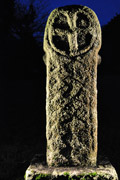
Object type: Cross-shaft and -head
Measurements: H. 138 cm (55.2 in); W. c. 42 cm (16.8 in); D. c. 22 cm (8.8 in)
Stone type: Examined from a distance. Poorly megacrystic granite. White feldspar megacrysts up to 2.5 by 0.6 cm form less than 1% of the rock; crystals of roughly equidimensional quartz up to 8 mm occur. Carnmenellis Granite
Plate numbers in printed volume: Ills. 322-5
Corpus volume reference: Vol 11 p. 245-6
(There may be more views or larger images available for this item. Click on the thumbnail image to view.)
A small round-headed cross with rectangular-section shaft and bosses at the neck, mounted on a modern base. Part of the bottom of the shaft is missing and on the top of the head is a slight hollow. The decoration, which consists mainly of chevrons, or zig-zags, and diamonds, formed by sinking rows of triangles, is quite badly worn especially on the shaft.
A (broad): The cross-head contains an equal-limbed cross, with slightly splayed cross-limbs, which is inclined slightly to the left. This is contained within a double edge-moulding. The shaft retains traces only of an incised edge-moulding, on the right side. The decoration on the shaft is in two parts separated by an incised line down the centre. That on the left consists of seven raised diamonds and half of an eighth. That on the right is badly worn but the remaining traces suggest an incised diamond or a zig-zag pattern.
B (narrow): An edge-moulding on both sides continues from the cross-head down the shaft. Between the head and the shaft is a boss c. 10 cm (4 in) in diameter. The decoration on the head consists of two incised horse-shoe shapes set one above the other, one inverted. That on the shaft consists of a series of incised diagonal crosses, all except those at the top of the shaft being intersected by horizontal incised lines to create a series of triangles.
C (broad): The cross-head contains an equal-limbed cross. The cross-limbs, especially the horizontal ones, are a little more widely-splayed than those on face A and merge with the inner line of the double edge-moulding. The shaft has a raised edge-moulding on both sides, but that on the right side is worn. The decoration on the shaft is, as on face A, in two parts. That on the left consists of eight diamonds and half of a ninth; each diamond is rather smaller than those on face A. The decoration on the right is worn but at the top appears to have consisted of an incised circle with a semi-circle or horse-shoe-like shape below it. Below this is a series of incised diagonal crosses.
D (narrow): As face B except that the boss is damaged and is slightly larger, c. 12 cm (5 in) in diameter. There is no incised decoration on the cross-head. The decoration on the shaft consists of a series of triangles or chevrons, formed by alternating sunken and raised areas.
Appendix D item (continuing tradition)
This cross is one in a small group in the Carnmenellis granite area bearing a simple geometric cross on the round (wheel) head and characterised by diamonds, chevrons or zig-zags, and other incised patterns (p. 107). The crosses in this group do duty as boundary stones and wayside crosses or mark chapel sites but none originally stood at parish church sites. In this case, the cross stood at a river crossing on the road from Stithians parish church to Rame, which is the location of another cross in the same group (Wendron 6, p. 251).
As with others in the group, the patterns of chevrons and diamonds indicate a Norman-period date. Again in common with others in the group, the cross has incised horseshoes, in this case unusually located on the side of the head, as well as a possible further example on face C, below an incised circle. The bosses at the neck are different from similar monuments but may be copied from the better executed roll-mouldings on Wendron 6 (Ill. 337).
