Select a site alphabetically from the choices shown in the box below. Alternatively, browse sculptural examples using the Forward/Back buttons.
Chapters for this volume, along with copies of original in-text images, are available here.


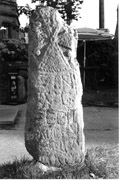
Object type: Part of cross-shaft and -head
Measurements: H. 117 cm (46.2 in); W. 34 cm (13.6 in) (head), 41 > 34 cm (16.4 > 13.6 in) (shaft); D. 18 > 9 cm (7.2 > 3.6 in)
Stone type: Colour is intermediate between yellowish grey (5Y 8/1) and very light grey (N8). Small (up to 0.2 mm by 10 mm) white feldspar phenocrysts (forming 20% or less of the rock) and clear quartz grains up to 3 mm across, but with only a few scattered grains of white mica, are set in a fine-grained, rhyolitic matrix. Elvan
Plate numbers in printed volume: Ills. 224-8, 358
Corpus volume reference: Vol 11 p. 201-3
(There may be more views or larger images available for this item. Click on the thumbnail image to view.)
Disc-headed cross of rectangular section, set on a modern (nineteenth-century) base. The sides of the head have been trimmed to make the stone roughly rectangular, presumably for re-use as a gate-post, and holes in the top of the head and in the face of the head on side C relate to this re-use. All the carving is incised or in very low relief.
A (broad): On the head is an expanded-arm cross, type E6, formed by slightly sinking the area between the arms. The arms flare widely from a small central boss; they are bordered by a double incised line, with a cable-moulding along the outer edge of the bottom arm. A small section of a flat, plain ring joins the outer edge of the bottom arm. Centrally placed within the spaces between the cross-arms are four small bosses.
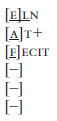
Down the mutilated sides of the shaft, framing an inscribed text, are traces of a single incised line, possibly terminated near the bottom by a small, very worn cross. The entire shaft is filled with the text. It is incised in six horizontal lines inside the remains of a panel and is incomplete at the end. The letters, measuring 6 to 7 cm in height, are in a predominantly capital script but are rather deteriorated. The text reads:
B (narrow): No decoration is visible as the side of the cross has been trimmed.
C (broad): The cross on this face is the same as that on A. At the centre, the cross is overlain by a small, low-relief boss, within which is a small sunken cross. Remains of the ring can be seen more clearly on this face. Filling the spaces between the ring and cross-arms are four small oval bosses, crudely carved to represent bearded heads. Small hollows represent the eyes and mouths.
Down the sides of the shaft are two incised lines, the outer forming an edge-moulding and extending to the base of the shaft, the inner terminated near the bottom with a small incised cross with slightly expanded terminals. The entire shaft is filled with an inscribed text. It is incised in several lines inside the remains of a panel and is now incomplete. Traces of five lines can be made out, the first two reading horizontally, followed by one reading downwards with the letters facing left, one reading horizontally and upside down, and one reading upwards with the letters facing right. The letters, measuring 6 to 8 cm in height, are in a predominantly capital script but are highly deteriorated. The text reads:

D (narrow): No decoration is visible as the side of the cross has been trimmed.
This cross is unique in Cornwall. Almost all of its attributes are without parallel amongst the pre-Norman crosses of Cornwall: its very small size, the shaft decorated with inscriptions only, the decoration of the head, the naming and depiction of the Evangelists (though see now Gulval 2), the crosses at the bottom of the edge-moulding, the central boss elaborated with a cross, and even the type of stone, are all different from the norm of Cornish pre-Norman sculpture. The cross lacks the usual features of interlace decoration and holes between the cross-arms and ring which distinguish the Cornish pre-Norman crosses from the later and much simpler disc- or wheel-headed wayside crosses. In fact, without the inscription, which supports a pre-Norman date and commemorates a person with a probable Anglo-Saxon name, it might be difficult to substantiate a pre-Norman date. With its disc- or wheel-head and simple outline, it could be said to have more in common with the later wheel-headed wayside crosses, although it is far more ornate than any of these.
On the other hand, the concept of a cross with inscriptions filling the whole of the shaft, the wide-splayed arms, and use of incised decoration on disc-headed crosses is found amongst the 'Disk-headed Slab-crosses' and '"Panelled-cartwheel" Cross-slabs' of south Wales which Nash-Williams dates broadly to the tenth and eleventh centuries (Nash-Williams 1950, 33, 38; Redknap and Lewis 2007, 117–18; and compare some stones in the Margam area, Redknap and Lewis 2007, 427–38). The disc-head is a common cross form in south Wales throughout the tenth and eleventh centuries, and although it is found in Cornwall on one early cross at Sancreed (Ills. 214–17), it is probable that Wales is the source of the form. The names of the Evangelists also appear on two crosses from south Wales (from St Davids: Nash-Williams 1950, 212, no. 383, pl. LVI; Edwards 2007, 444–6, dated late eleventh to twelfth century; and from Llanhamlach: Nash-Williams 1950, 76–7, no. 61, pl. LIII; Redknap and Lewis 2007, 210–13, dated tenth to eleventh century).
The closest parallel in Cornwall is with the two stones at Lanteglos by Camelford, described separately in this volume but probably parts of one original monument (pp. 164, 166, Ills. 131–5, 136–7). The latter is overall far simpler, but the general form of the cross-head, with its arms flaring widely from a very small central boss, and the bosses within the spaces between the arms is very similar and the use of inscriptions on two faces of the shaft is comparable. The names on this stone are also, as with those on Tintagel 1, of English origin, but the Lanteglos text is Middle English and is dated to the late eleventh or twelfth century.
Cable-mouldings are used in Cornish sculpture on two other crosses, on Gulval 1 in west Cornwall (Ills. 83–6), and possibly Quethiock (Ill. 208), but also feature quite regularly in the county's Romanesque work. The disembodied little heads are quite unparalleled in Cornwall, unless they can be compared to Norman beak-heads or, perhaps more appropriately, to the use of heads on the corners of fonts of the influential Bodmin series (Sedding, E. 1909, 454–6). The nearest of these is the curious debased example in Tintagel's early Norman church, dated by Sedding to c. 1130–1150 (Sedding, E. 1909, 385).
The text on face A reads: [E]LN[A]T + [F]ECIT –, '[E]ln[a]t made –' (Ill. 227). Earlier readings, made when the text was less deteriorated, suggest that the name might have been Ælnat, and that the text continued, with abbreviations expanded, hanc crucem pro anima sua, 'this cross for his soul' (see Okasha 1993, 293–4). The name may have been of English origin and be that of the carver or the commissioner of the cross.
The text on face C reads: [M.T..S] [M–] LUC[.]S IO[.] (Ill. 228). Earlier drawings, for example by Langdon (Langdon, Arthur 1896, 366, 368), show a less deteriorated text set around the stone and reading matheus marcvs lucas ioh, where ioh, with an abbreviation mark, is for iohannes. This reading is supported by other drawings, as well as the traces remaining today, and is likely to be substantially correct.
In conclusion, the cross can be seen to have a range of cultural influences. Its form has much in common with south Welsh sculpture and the references to the Evangelists can be paralleled there too. The name on it is English, and the use of little heads is reminiscent of Norman work. The fact that this cross is not really like anything else in Cornwall of either pre- or post-Norman Conquest date makes it difficult to date. The comparisons with Lanteglos, however, and the fact that the head can perhaps be related to Norman sculpture, suggest that it should be dated to the latter half of the eleventh century, even the early twelfth. The widely flaring form of the cross-arms also points to a later date. On the other hand, the Welsh parallels suggest that an earlier date is possible.
