Select a site alphabetically from the choices shown in the box below. Alternatively, browse sculptural examples using the Forward/Back buttons.
Chapters for this volume, along with copies of original in-text images, are available here.


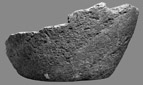
Object type: Part of font bowl
Measurements: H. 38 cm (15 in); Diam. of top of bowl 75 cm (estimated); Diam. of bottom of bowl c. 46 cm (c. 18 in) (external), c. 32 cm (c. 12.5 in) (internal); Depth 24 cm (9.5 in); Diam. of hole 3.6 cm (1.3 in)
Stone type: Purplish grey, foliated, vesicular, volcanic tuff with grey slate fragments included. Elongated vesicles up to 1 cm across lie parallel to the bedding. Tintagel Volcanic Formation
Plate numbers in printed volume: Ills. 271-4
Corpus volume reference: Vol 11 p. 223-4
(There may be more views or larger images available for this item. Click on the thumbnail image to view.)
Three broken fragments of an undecorated stone bowl with a thick wall and base and a tapering, rounded rim. The dimensions above refer to the largest piece. The other two fragments, which include a section of the side and a piece of the rim, are very much smaller. The bowl has a small drain-hole in the bottom and a well-defined foot-ring. Tooling marks can be seen on both inner and outer surfaces in places where the surface remains smooth and intact. Inside, the sides are quite smooth but the bottom is very rough, and not absolutely level. The hole is very neatly cut, circular, and of the same diameter through the complete thickness of the bowl. It is not absolutely central. Two cuts in the inside of the bowl may possibly represent the marks made by a pick when the stone was broken up. Filling two small grooves on the outside of the bowl are small areas of lime mortar, which look as though they were intended to make up and level the surface of the stone in places where the natural stone contained a small void or vesicle.
Appendix A item (stones of uncertain date)
This is the most important example of a possible early medieval font, because its excavated context makes it potentially dateable; claims of an early medieval date have been made (Nowakowski and Thomas, A. C. 1992, 16; Thomas, A. C. 1993, 108–9) and supported (Blair 2010, 161). If this is genuinely early medieval, then other plain bowls of similar size may be so as well.
The first thing to establish is whether this bowl is undoubtedly a font. The ecclesiastical setting certainly makes it a possibility, and its dimensions are very much in line with the sizes of simple early Norman fonts in Cornwall. The estimated diameter of the top, for example, is only a little bigger than the external diameter of the Morwenstow font (Sedding, E. 1909, 295), and the depth of 24 cm or 9.5 in is very close to that of a number of early Norman fonts in Cornwall, for example Germoe (26 cm/10 in), St Giles (23 cm/9 in), St Clether (23 cm/9 in): Sedding, E. 1909, 154, 157, 58. The rounded top of the rim is a little unusual as Cornish examples normally have a flat top; however Blair's illustrations of fonts at Deerhurst and Asthall do suggest rounded rims (Blair 2010, 156, fig. 3). Likewise the flat bottom is unusual, although in connection with the simple bowl-like font at St Clether, Sedding notes that 'as is usual with fonts of this character, the bottom is nearly flat' (Sedding, E. 1909, 58); a font at Poltimore in Devon is of similar form (Blair 2010, 165, fig. 8b). Tintagel 2's bottom is also flat but not level, which would have made it difficult to drain: perhaps this explains in some way the abraded appearance of the floor. Other features which may support interpretation as a font are the good finish both inside and out and the fact that trouble was taken to fill holes in the exterior with mortar to level the surface. Such attention to detail might not have been lavished on an artefact intended for domestic use. On the other hand, the Boscastle 1 corn measure (see Ills. 246–7) also has a flat floor and overall dimensions which are very similar to Tintagel 2. Despite this, the evidence seems in favour of interpretation of Tintagel 2 as a font.
Nonetheless the date remains uncertain because of the simplicity of the artefact and because its context is not securely dated. Of the building into which the font fragment was incorporated 'only circumstantial evidence for the moment exists for the date of its construction and for its interpretation as an early church' (Nowakowski and Thomas, A. C. 1992, 14): and part of that circumstantial evidence is the font itself, dated by comparison with the Potterne font in Wiltshire to the tenth century (Nowakowski and Thomas, A. C. 1992, 16). Although some doubt exists about the date of the Potterne font, it is generally accepted as early medieval (Cramp 2006, 40; Blair 2010, 155, 158–60): however, since Tintagel 2 does not really resemble it, this is perhaps irrelevant.
Other pieces of circumstantial evidence include pottery of the appropriate period (but unstratified), the uni-cameral plan of the building, and comparison with other allegedly pre-Conquest churches in Cornwall (for example Minster, although Allan disagrees: Allan 2004–5, 150). A window fragment found in a demolition spread within the building was considered likely to be of 'late Saxon' date (Nowakowski and Thomas, A. C. 1992, 16), although this would be unparalleled in Cornwall, and it could perhaps be early Norman instead. The building's walls were bonded with a shell-based (that is, lime) mortar (Nowakowski and Thomas, A. C. 1992, 14) something suggested elsewhere by Thomas as likely to be indicative of a Norman, rather than an early medieval, date (Russell and Pool 1968, 53; Thomas, A. C. 1968a, 11–14). The building was said to overlie the location of the early Christian cemetery (Nowakowski and Thomas, A. C. 1993, 14) and the compacted rubble fill of the building, which was not excavated to floor level, had several post-medieval burials inserted into it (Thomas, A. C. 1993, 107). In summary a relatively wide date range is possible for the building.
Further doubt about the antiquity of both the artefact and the building into which it was built relates to the fact that the hole in the base of the bowl is very neatly cut, completely circular, looks relatively unworn and is of the same diameter through the thickness of the stone, in contrast with the other alleged fonts in this appendix. In granite, a hole like this might be regarded as nineteenth-century in origin; in the early medieval granite crosses described in the main catalogue the holes in the heads are normally of hour-glass or irregular profile, having been drilled from two sides. The volcanic tuff from which this bowl is cut is, however, a softer rock which would have been capable of more precise drilling. The lime mortar used to fill irregularities in the bowl is also a potentially important piece of evidence. Given that there are very few buildings and no certain churches of early medieval date known in Cornwall, the earliest certain use of lime mortar in Cornwall dates to the Norman period, and such evidence as we have indicates that lime was used in only small quantities in early mortars. Its presence on the stone may therefore point to a later date, although information on the use of mortars in eleventh- and twelfth-century Cornwall is admittedly scarce.
Given these circumstances, the tenth-century date suggested by the excavators must be regarded as uncertain and unlikely to be proven even once the excavation is fully published. As the excavators pointed out, only further excavation is likely to provide positive answers either to the dating of the font, or to the nature and relationships of the building. The date suggested here reflects the bowl's overall similarity to undoubtedly early Norman fonts in Cornwall but admits the possibility that it might be earlier. The existence of an early Norman church at Tintagel may provide a ready context for this font (Sedding, E. 1909, 382–8; Berry n.d., 27–34). A slightly more elaborate Norman font still surviving in Tintagel church may represent a replacement provided when the church was enlarged in the later twelfth century.
