Select a site alphabetically from the choices shown in the box below. Alternatively, browse sculptural examples using the Forward/Back buttons.
Chapters for this volume, along with copies of original in-text images, are available here.


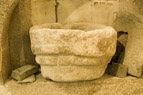
Object type: Alleged font bowl
Measurements: H. 30.05 cm (12 in); Diam. of top of bowl 53 > 49 cm (21 > 19.5 in) (external), 37 > 34 cm (14.5 > 13.5 in) (internal); Diam. of bottom of bowl c. 38 cm (c. 15 in); Depth 22.5 cm (9 in); Diam. of hole 10 > 6.25 cm (4 > 2.5 in)
Stone type: The sub-angular to sub-rounded grains of clear quartz vary from 0.3 to 2.0 mm and set in a white felsitic matrix. Elvan (R.T.T.)
Plate numbers in printed volume: Ills. 275-6
Corpus volume reference: Vol 11 p. 225
(There may be more views or larger images available for this item. Click on the thumbnail image to view.)
Tub-shaped bowl, with a rounded rim. Around the top of the bowl is a plain flat moulding, varying from 18 cm (7 in) to 12.5 cm (5 in) in height. Below this is a deep plain moulding with a rounded profile, 5.5 cm (2 in) high and 3 cm (1.1 in) deep.
The interior of the bowl has straight sides and a rounded bottom. The rather large hole has a wide tapering top edge with an incised circular mark which may have been made by a plug. Around the rim of the bowl are three cross-shaped depressions which may have held fixings of some sort and on the inner edge are two diagonal wear marks.
Appendix A item (stones of uncertain date)
Although claimed as an early Norman font (Canner 1982, 11) or 'perhaps just before the Norman Conquest' (Thomas, A. C. 1993, 113), the origin of this bowl is far from certain.
The bowl is rather smaller than most fonts. The only certain example which is of comparable size in Cornwall is the early Norman font from Sithney (Sedding, E. H. 1909, 53–4, pl. XX). Otherwise it is closest in size to the stone bowls from Boscastle and from Trethevey in Tintagel (Tintagel 4), both of uncertain origin (Ills. 246–7 and 277–9). Its irregular shape need not mean it is not a font: the early Norman font at Tresmere is an unusual triangular form, reflecting the shape of the stone from which it was cut (Sedding, E. 1909, 397–8, pl. CLXII), while the irregular oval form of Morwenstow's is well known (Sedding, E. 1909, 295, pl. CXXII).
Against interpretation as a font is the fact that the chapel on the island was never licensed for baptism, although a very early chapel might have baptismal and burial rights by tradition, and a chapel associated with the thirteenth-century castle might have had such rights by reason of its status. The date of the chapel, however, is far from secure. Although partly excavated by Radford who considered it of twelfth- and thirteenth-century date (Radford 1935, 407), Thomas has since argued that it may be eleventh century in origin (Thomas, A. C. 1993, 110–14; followed by Barrowman, Batey and Morris 2007, 322). Be that as it may, the bowl's original association with the chapel is also far from secure, since it is said to have been removed from there over a hundred years ago. Moreover, even if it was found in the chapel, the possibility exists that it could initially have been associated with the castle as a domestic bowl, and then moved to the chapel if it was later thought to be of ecclesiastical origin — the fate of a number of stone mortars and querns (Worth 1967, 390–1).
The various holes and depressions on the rim suggest that, even if it did originate as a font, this bowl has also seen heavy use for some other purpose. In favour of an origin as a font is the fact that a domestic bowl might not have a hole in the bottom and might not be decorated, even though the decoration (two plain mouldings) is very simple.
