Select a site alphabetically from the choices shown in the box below. Alternatively, browse sculptural examples using the Forward/Back buttons.
Chapters for this volume, along with copies of original in-text images, are available here.


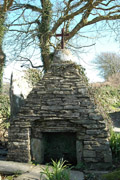
Object type: Alleged font bowl
Measurements: H. 30 cm (12 in); Diam. of top of bowl c. 48 cm (c. 19 in); Diam. of bottom of bowl 33 cm (13 in); Diam. of hole 4 cm (1.5 in)
Stone type: Yellowish grey (5Y 7/2) granite with white, elongate, feldspars mostly between 0.2 and 0.5 mm, but a few megacrysts up to 10 mm, together with sub-spherical, clear quartz grains between 0.3 and 0.6 mm across and scattered flakes of white mica. Bodmin Moor Granite
Plate numbers in printed volume: Ills. 277-9
Corpus volume reference: Vol 11 p. 226
(There may be more views or larger images available for this item. Click on the thumbnail image to view.)
The bowl is inverted on top of a small well-house, with an iron cross inserted into a hole in the bottom. It is an undecorated tapering 'pudding basin' shape. In one place on the rim is a small area of lime-wash.
Appendix A item (stones of uncertain date)
The suggestion that this might be a re-used artefact seems entirely possible. Whether it is an early font is open to dispute, however.
Unlike the Boscastle 1 stone (p. 211, Ills. 246–7), Tintagel 4 does have a potential ecclesiastical context. The hamlet of Trethevey is the site of a chapel of St Piran which (probably reasonably) has been equated with the chapel of St Piran recorded in the parish of Tintagel in 1427 and which is likely to have been of pre-Norman origin. Part of Trethevey's lands included the Domesday manor of Tregrebi or 'Genver' which before the Norman Conquest was 'of the possession of St Piran' (Thorn and Thorn 1979, 5,8,10): it appears to have been a remote holding of St Piran's monastery at Perranzabuloe (Canner 1982, 29–30), with which it lost its association at the Norman Conquest. The focus of the manor appears to have moved at a fairly early date from Genver to Trethevey, for while Trethevey survives now as a substantial hamlet, Genver, close to the parish boundary, is hardly recorded at all, is now deserted and is represented on nineteenth-century maps as a single farmstead only. Canner notes that the early history of Trethevey is more elusive than any other part of the parish of Tintagel and that, lying on the edge of the parish of Tintagel, it seems to have enjoyed considerable independence; it seems quite possible that this part of the parish, remote from the parish church, originated as a semi-parochial chapelry, becoming part of Tintagel after the Norman Conquest (Canner 1982, 29–31, 37; Preston-Jones 2006, 11). Thus although the chapel is recorded only once and had no known right of baptism, there is a remote possibility that it was at one time independent of the mother church and might have had a font.
However, as with the Boscastle 1 'font' and Tintagel 3 (Ills. 246–7, 275–6), the small size may argue against such an interpretation and favour some sort of domestic use.
