Select a site alphabetically from the choices shown in the box below. Alternatively, browse sculptural examples using the Forward/Back buttons.
Chapters for this volume, along with copies of original in-text images, are available here.


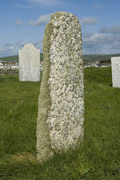
Object type: Pillar-stone
Measurements: H. 127 cm (50 in) (above ground now; full height c. 180 cm); W. 43 > 23 cm (17 > 9 in); D. 36 > 17 cm (14 > 7 in)
Stone type: Coarse-grained, abundantly megacrystic granite composed of about 20% quartz, 70% feldspar and 10% tourmaline (schorl) (luxullianite?). The scattered off-white to pale pink feldspars are up to 7 cm by 1 cm. The tourmaline occurs as discrete crystals and also overgrown and intergrown into both the quartz and feldspar. St Austell Granite (R.T.T.)
Plate numbers in printed volume: Ills. 281-4
Corpus volume reference: Vol 11 p. 227
(There may be more views or larger images available for this item. Click on the thumbnail image to view.)
Pillar of granite worked to a roughly cylindrical shape, tapering at both ends. It has a very rough surface as a result of decay of the feldspar-rich stone; this and the thick covering of lichen make it difficult to discern any ornamentation other than two small circular holes (5 and 4 cm (2 and 1.5 in) in diameter), one above the other, one metre (39 in) from the top on the north side and, on the east, an incised semi-circular arc. Photos taken during excavations in 1990 show a single hollow in the side — this is currently not visible, unless it is a mistaken interpretation of the photo and is in fact identical with the two hollows noted above. A possible equal-armed outline cross, seen on the photo of the south side (Ill. 282), was not noted on site and requires checking. In 1990, the thick covering of lichen was cleaned off with a wire brush in the hope of finding an inscription, but none was discovered (J. Nowakowski, pers. comm.)
Appendix A item (stones of uncertain date)
This stone is probably not the same as that described by Langdon in 1896 as the stump of a cross (Langdon, Arthur 1896, 225), despite an assertion to this effect by Thomas (Thomas, A. C. 1992, 4); the stone Langdon was referring to was probably the 'cross (remains of)' marked on early Ordnance Survey maps at the south entrance to the churchyard. Ellis found only a small portion protruding above ground level; his illustration and described location make it clear that he was referring to the present stone (Ellis, G. 1962–4e, 274–5). In 1942 it was excavated by the vicar, Rev. E. D. Arundell, who at the same time discovered a considerable depth of deposits and cist graves (Canner 1982, 2–3, 104; Thomas, A. C. 1988b, 85–90). Thomas suggests that Arundell's excavation was in part aimed at digging out and re-erecting the stone (Thomas, A. C. 1993, 64–6). In excavation on the site in 1990 and 1991, Nowakowski and Thomas discovered what they thought was the socket for this stone: a 0.45 m (17.5 in) deep, flat-bottomed pit dug into bedrock with remnants of packing stones around the top (Nowakowski and Thomas, A. C. 1992, 6–9; Thomas, A. C. 1993, 103, 106, fig. 83; see Ill. 393). Although it did not mark any particular graves, the stone (or whatever was erected in the socket) was thought to have been a focal point in the graveyard.
The incised arc could perhaps be compared with the semi-circular line framing the top of sixth- and seventh-century inscribed stones at St Endellion, Southill and Welltown, Cardinham (Thomas, A. C. 1994, 294–5, fig. 17.15); decoration on Wareham 2, Dorset could also be compared (Cramp 2006, 117, ills. 122–5). Two small hollows are also visible on the Feock pillar-stone (see pp. 51–2).
