Select a site alphabetically from the choices shown in the box below. Alternatively, browse sculptural examples using the Forward/Back buttons.
Chapters for this volume, along with copies of original in-text images, are available here.


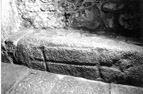
Object type: Grave-cover
Measurements: L. 189 cm (74.5 in); W. 45 cm (17.8 in); D. 28 cm (11 in) (max.)
Stone type: Coarse-grained Land's End Granite (A.V.B.)
Plate numbers in printed volume: Ill. 326
Corpus volume reference: Vol 11 p. 246-7
(There may be more views or larger images available for this item. Click on the thumbnail image to view.)
Only two faces of this cross-incised slab are visible; both have carving on them.
A (top): An incised double-barred cross extends over half of the length of the slab, its arms reaching almost to the edges of the stone. The cross is widely incised and the ends of the cross-arms expanded. Along one long edge is a possible recessed edge-moulding and near one end is a possible single incised line.
B (narrow): On the flat upper surface of the stone (the seat) is a small incised motif resembling a triple-barred cross.
Appendix D item (continuing tradition)
This slab was considered by Langdon to be a 'very rare' example of an early cross-slab in Cornwall, and in marked contrast with the floriated cross-slabs of the thirteenth and fourteenth centuries (Langdon, Arthur 1896, 419). Thomas concurs, suggesting a possible tenth-century parallel for this monument at Spennithorne in Yorkshire (Thomas, A. C. 1968a, 14; Lang 2001, 198, ill. 745). However the latter is altogether more ornate than the Towednack slab, and features early medieval decoration, which Towednack does not. On the other hand, parallels for the form of the incised cross can be found on Cornish wayside crosses, although the examples, which include the nearby Penbeagle Cross, St Ives (Langdon, Arthur 1896, 248–9), are all single-barred. Instances can also be found of a cross-head at both ends of a slab on medieval grave-covers in other parts of the country, for example at Kirkheaton St John, Yorkshire (Ryder 1991, 33) or Winterbourne in Buckinghamshire (Cutts 1849, pl. LIII). It therefore seems most likely that this is a post-Norman Conquest grave-slab, and the length of the stone certainly suits this, although it is rather thicker than most. On the other hand, the fact that Towednack is a chapelry which did not acquire burial rights until 1542 (Henderson, C. 1957–60b, 449) makes this interpretation questionable. A wide date range, extending up to the period when the church gained burial rights, is therefore suggested.
The small triple-barred mark on the upper horizontal face of the stone may be compared to a stone at Ludgvan church, initially taken for an early cross-slab (Thomas, A. C. 1966b, 86) but more recently interpreted as a small granite headstone of seventeenth-century date bearing the initials 'JJ' (Thomas, A. C. 2000–1, 224, fig. 4). Similarly the motif on the Towednack slab is likely to be a piece of modern graffiti (Thomas, A. C. 2000–1, 225, 227).
