Select a site alphabetically from the choices shown in the box below. Alternatively, browse sculptural examples using the Forward/Back buttons.
Chapters for this volume, along with copies of original in-text images, are available here.


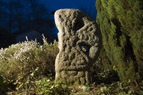
Object type: Part of cross-head and -shaft
Measurements: H. 87 cm (34.8 in); W. 47 cm (18.8 in) (head), 38 cm (15.2 in) (shaft); D. 20 cm (8 in) (head), 23 cm (9.2 in) (shaft)
Stone type: Coarse-grained, poorly megacrystic, granite with sparse feldspars megacrysts up to 2.5 by 0.6 cm set in a roughly equigranular mix of feldspar and quartz (but with some quartz up to 8 mm across) and sparse white mica up to 1 mm across. St Austell Granite
Plate numbers in printed volume: Ills. 234-7, 389-90
Corpus volume reference: Vol 11 p. 205-6
(There may be more views or larger images available for this item. Click on the thumbnail image to view.)
Broken cross-head with part of shaft. The cross-head, type E8, has wide-splayed cross-arms which protrude beyond the slightly recessed ring, type a.
A (broad): Within an incised edge-moulding in each of the arms of the head is a badly worn triquetra knot, that in the left-hand limb being wrongly cut. The triquetras are possibly linked to the central boss by a spine or to each other: the cross is too worn to be sure. At the centre of the head is a small hole. On the shaft are traces of decoration, possibly the top of a plant-scroll or a ring-knot, but too little survives to be certain.
B (narrow): There are slight remains of an incised edge-moulding around the perimeter of the cross-arm. The ring features a double roll-moulding. Within the incised edge-moulding on the shaft is step pattern 2 (Romilly Allen no. 887, the Welsh J4 – see Fig. 19b, p. 72).
C (broad): This face is extremely worn, especially at the top. The only decoration to survive is a double roll-moulding on the lower part of the ring, and faint traces of decoration on the horizontal and bottom cross-arms.
D (narrow): The cross-arm is broken off. On the shaft are slight remains of decoration, possibly a step pattern.
Only a very worn fragment of the cross remains, making parallels and dating difficult. Such as they are, the best parallels can be drawn with Cardinham 1 (Ills. 43–6), although the Trenython cross is smaller. The shape of the head is reminiscent of Cardinham 1, which also has a simple step pattern, though on the head rather than the shaft. The linked triquetras (if that is what they are) on the head can also be compared. However the best parallel for the step patterns on both sides of the shaft are found on Gulval 1 (Ills. 84, 86), in west Cornwall. The moulded ring is a particular feature of the Cornish crosses with triquetra-shaped holes between the cross-arms.
Discussion of the original context of the stone is complicated by the fact that the location of the 'dried up pond' in which the stone was first found is not clearly specified. It may have been within the ornamental grounds at Trenython itself (Langdon, Andrew 2002, 71) or, as stated sixty years after the original discovery, opposite the smithy at Four Turnings (Baird and White unpub. 1961, 867–8). This is further complicated by the fact that Four Turnings is the name usually applied to the crossroads (now a roundabout) nearly 2 km south-east of Trenython, where there is no evidence of a former smithy or pond; on the other hand a smithy and pond are shown on early editions of the Ordnance Survey at the crossroads only 0.5 km north-north-east of Trenython, at SW 103 545. The latter is therefore considered most likely and makes a better context than Trenython itself, which has no history or tradition of a chapel site or other ecclesiastical origin (other than in the nineteenth century, when it was briefly the residence of the Bishop of Truro).
The smithy and pond are on the ridge of high ground to the north-north-east of Trenython, a ridge on which Castle Dore hillfort and the Castledore inscribed stone are located (Okasha 1993, 91) and which forms the boundary between the parishes of St Samson Golant and Tywardreath (in medieval times the boundary of the chapelry of Golant within Tywardreath). In or near this location, the cross would have stood beside the ridgeway leading from Fowey to Lostwithiel and Bodmin, at a junction of this road with routes to the parish churches of St Samson and Tywardreath. It may also have marked an early parochial boundary, although the parochial unit that preceded Tywardreath is uncertain since the present parish owes its origin to the foundation here of a Benedictine priory soon after the Norman Conquest (Henderson, C. 1957–60b, 462–8). Tywardreath, however, was a significant Domesday manor held by the tenant-in-chief Richard Fitz Turold (Thorn and Thorn 1979, 5,3,8), so it is not unreasonable to assume that a manorial church or chapel may have preceded the present parish church and priory.
