Select a site alphabetically from the choices shown in the box below. Alternatively, browse sculptural examples using the Forward/Back buttons.
Chapters for this volume, along with copies of original in-text images, are available here.


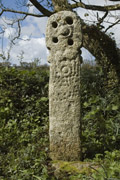
Object type: Cross-shaft and -head
Measurements: H. 164 cm (65.6 in); W. 39.5 cm (15.8 in) (head), 34 cm (13.6 in) (shaft); D. 25.5 cm (10.2 in) (head, max.), 22 cm (8.8 in) (shaft)
Stone type: Heavily lichen-encrusted, non-megacrystic granite (one exception, a feldspar measuring 3.5 by 0.5 cm). Most quartz crystals roughly equigranular and less than 1 cm across. Carnmenellis Granite
Plate numbers in printed volume: Ills. 328-9; Colour Pl. 25
Corpus volume reference: Vol 11 p. 248-9
(There may be more views or larger images available for this item. Click on the thumbnail image to view.)
Complete rectangular-section cross, with a projecting roll-moulding at the neck. The head is rounded at the top with straight sides and the shaft is straight. Decoration includes bosses, incised lines and dots.
A (broad): The cross-head contains four circular holes, of different diameters and set irregularly. In the centre is a boss, surrounded by a wide moulding. The shaft has faint traces of an incised edge-moulding. Within this, at the top of the shaft, is a rectangular projection with a small encircled boss below it. Surrounding the boss, and continuing part way down the shaft, are irregular rows of incised dots. Beneath these are four or five vertical incised lines set asymmetrically. The lower part of the shaft is apparently undecorated.
B (narrow): The cross-head is plain. Above the neck is a small boss placed to the right side, with roll-moulding below. The top of the shaft contains two rows of projecting vertical bands, four in the upper row and three in the lower. Beside the three projecting bands, and also beneath them, are rows of irregularly placed incised dots. Beneath these are three panels defined by incised lines. The lowest panel contains an incised line, dividing it into two, and may have been left open at the bottom.
C (broad): The cross-head contains four circular holes, of more regular size and set more symmetrically than are those on face A. In the centre is a boss, surrounded by a wide moulding. The shaft has an incised edge-moulding which continues some way down the shaft; it is single on the left side but double on the right. Within this, at the top of the shaft, is a rectangular projection, rather narrower than that on face A. Beneath it are six projecting vertical bands with rounded ends, the two outer ones being longer than the others. Below this, and continuing as far down as the edge-moulding, are rows of incised dots set irregularly. In the middle of these, and towards the left side, is an encircled boss, as on face A, but larger in size and set lower down the shaft. The bottom of the shaft is apparently undecorated.
D (narrow): The cross-head is plain. Above the neck is a small boss placed to the right side, with roll-moulding below. The top of the shaft contains one row of incised dots followed by a panel containing irregular rows of incised dots. Beneath this is an incised band followed by a plain panel, an incised line and another small panel of incised dots. Following another incised band is the start of a plain panel which may have been left open at the bottom.
Appendix D item (continuing tradition)
The incised decoration, the unusual shape and bizarre decorative scheme of this cross suggest that it is likely to be of post-Norman Conquest date. Its relationship to the early medieval ring-headed crosses is seen in the appearance of four holes and a boss on the head, but like the Phillack 1 cross (p. 193, Ills. 197–201), for which a late eleventh-century date has been proposed, further bosses are set in unusual places. Here however the resemblance to the pre-Norman crosses ends and such parallels as there are, are with Transitional or Continuing Tradition monuments (Chapters IX and X, pp. 96, 101). Even so, the decoration is so unusual that there is little to compare it with and no definitively datable features.
The incised dots can be compared to the similar decoration on the crosses at Penzance and Eastbourne (from Kenwyn, Tregavethan), for which an eleventh- to twelfth-century date has been proposed (pp. 157, 186, Ills. 103–9, 185–8). The rough panelling of the decoration is also reminiscent of these. The raised panels on front and back just below the neck of the cross might perhaps be compared to the 'collar' on the cross at St Dennis (Ills. 294–9). However, the closest in form and design to the Mertheruny cross is that in the churchyard at Roche, although the latter is very much larger (Ills. 312–15). As with the similar decoration on Roche 1, the raised lines on faces A and D can be compared with Romanesque decoration.
A suggestion that the cross may date from about ad 1000 and mark the foundation of Mertheruny chapel site appears to lack substance, especially since it is known that the cross has been re-fixed (Langdon, Arthur 1896, 346; Thomas A. C. 1968b, 81–2). However excavation here did establish that the small curvilinear enclosure within which the cross is located started life as an Iron Age or Romano-British round, whose earliest use as a chapel yard is indicated by finds of bar-lug pottery (Thomas A. C. 1968b, 81–2). Henderson suggested that the chapel had its own parochial limits but for some reason never attained full parochial status (Henderson C. 1957–60b, 476–7).
