Select a site alphabetically from the choices shown in the box below. Alternatively, browse sculptural examples using the Forward/Back buttons.
Chapters for this volume, along with copies of original in-text images, are available here.


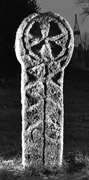
Object type: Cross-shaft and -head
Measurements: H. 134.5 cm (53 in); W. 45.7 cm (18 in) (head), 34.3 > 31.7 cm (13.5 >12.5 in) (shaft); D. 24 > 16.5 cm (9.5 > 6.5 in)
Stone type: Coarse-grained, poorly megacrystic, granite with a few feldspar phenocrysts up to 4 cm by 0.5 cm. Equidimensional quartz crystals up to 5 mm across occur, together with a few flakes of white mica up to 1 mm across and some scattered tourmaline. Carnmenellis Granite
Plate numbers in printed volume: Ills. 330-3
Corpus volume reference: Vol 11 p. 249-50
(There may be more views or larger images available for this item. Click on the thumbnail image to view.)
Appendix D item (continuing tradition)
This cross is one of a small group in the Carnmenellis granite area bearing a simple geometric cross on the round (wheel) head and characterised by chevrons or zig-zags and other incised patterns on the shaft (p. 107). The crosses in this group do duty as boundary stones and wayside crosses or mark chapel sites but none is associated with a parish church.
The prominent chevron pattern on the main face of this cross is indicative of a Norman-period date. This is supported by the forms of the crosses on the head which are similar to the Early Geometric crosses seen on medieval grave-covers elsewhere and dated by Ryder to the late eleventh to twelfth centuries (Ryder 1991, 50–1). Likewise, the horseshoe-like motifs on the shaft are reminiscent of the horseshoe emblems incised on medieval grave-slabs (for example Rothwell, Yorkshire: Ryder 1991, 40). Although Langdon in a footnote (Langdon, Arthur 1896, 332n) implies a possible late origin for the motif on this cross, this seems unlikely given that horseshoes appear on other monuments in the group and that they are as worn as the rest of the decoration on the cross.
Like another similar monument from Camborne parish (Camborne 4, p. 234) this cross was originally associated with a holy well site.
