Select a site alphabetically from the choices shown in the box below. Alternatively, browse sculptural examples using the Forward/Back buttons.
Chapters for this volume, along with copies of original in-text images, are available here.


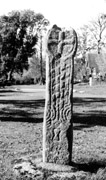
Object type: Cross-shaft and -head
Measurements: H. 175 cm (69 in); W. 42 cm (16.5 in) (head), 35.5 > 31.5 cm (14 > 12.4 in) (shaft); D. 26 > 17 cm (10.3 > 6.8 in)
Stone type: Carnmenellis Granite (A.V.B.)
Plate numbers in printed volume: Ills. 334-6
Corpus volume reference: Vol 11 p. 250-1
(There may be more views or larger images available for this item. Click on the thumbnail image to view.)
Round-headed cross with shaft of rectangular section, set in a modern base. On the front and back of the shaft are various incised motifs.
A (broad): On the head is an incised edge-moulding. Within this is a cross with arms only slightly expanded at the ends, formed by sinking four triangular areas. At the centre is a small hollow. Decoration on the top half of the shaft comprises five parallel incised vertical lines and, superimposed on these, two asymmetrical lines of sunken triangles, their points towards the middle. All the vertical incised lines, except the outer left and the central ones, terminate on top of the next pattern, which consists of two back to back semi-circles each formed of four concentric lines. The outer left vertical incised line ends at the bottom of the semi-circular motif; the central incised line runs down between the two semi-circles to terminate on a small circle. Immediately below this is an incised hour-glass or chalice motif. The lower part of the shaft is plain.
B and D (narrow): No trace of any ornament
C (broad): On the head is a cross formed by four incised triangles, their inner angles linked by diagonal lines. On the shaft, two incised lines run part way down the edge on the right-hand side, one on the left. The bottom edge of the head is continued by a curved incised line and hanging from this is an incised hour-glass or chalice. Further incised markings on the shaft may represent the worn remains of a chevron pattern, beneath which is a small circle and below it a larger one, about half way down the shaft.
Appendix D item (continuing tradition)
This cross is one of a small group in the Carnmenellis granite area bearing a simple geometric cross on the round (wheel) head and characterised by chevrons or zig-zags and other incised patterns on the shaft (p. 107). The crosses in this group do duty as boundary stones and wayside crosses or mark chapel sites but none are associated with parish church sites.
The form of the cross on face A compares with one on a grave-slab from Calverley, Yorkshire, dated to the eleventh or twelfth century by Ryder (1991, 17). The incised triangles are reminiscent of Romanesque zig-zag work as seen, for example, on the Carnmenellis font (originally from Sithney: Sedding, E. 1909, 53–4, pl. XX). Incised concentric circles are seen on the Cuby font, dated by Sedding as late Norman (Sedding, E. 1909, 80–1, pl. XXXII). The hour-glass motif can be compared with the chalices incised on medieval grave-slabs and, if this interpretation is correct, the circle above the motif on face A may represent a communion wafer. However the chalices seen on grave-slabs are normally more ornate, with a knop on the stem: see examples in Ryder 2005, 54–5. Thus although Thomas suggested that this may be a pre-Norman monument (Thomas, A. C. 1967a, 90), the range of decorative motifs and the shape of the cross on the head combine to indicate a post-Norman Conquest date.
Langdon's description of the original location of the cross shows that it functioned both as a wayside cross, marking a cross-roads, and as a parish boundary stone. It stood 'on the greensward, by four cross-roads, at the north-west corner of Nine Maidens' Down, which is the meeting-point of the four following parishes: Illogan, Camborne, Crowan, and St. Wendron' (Langdon, Arthur 1896, 329). This cross is recorded under Wendron, since this is the parish in which the majority of crosses in this group are found; however it might equally have been recorded as belonging to any of the other three parishes.
