Select a site alphabetically from the choices shown in the box below. Alternatively, browse sculptural examples using the Forward/Back buttons.
Chapters for this volume, along with copies of original in-text images, are available here.


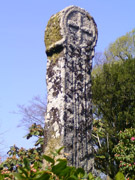
Object type: Cross-shaft and -head
Measurements: H. 226 cm (89 in); W. 47 cm (18.5 in) (head), 38.5 > 36 cm (15.25 >14.25 in) (shaft); D. 28 cm (11 in)
Stone type: Scattered white feldspar megacrysts, mostly up to 2.5 x 0.5 cm, form about 5% of the rock, with other, smaller, feldspars forming about 50%; white mica up to 1 mm across forms less than 0.1%, with the remainder of the rock formed of roughly equidimensional clear quartz up to about 10 mm across. Carnmenellis Granite
Plate numbers in printed volume: Ills. 337, 346-9; Colour Pl. 24
Corpus volume reference: Vol 11 p. 251-2
(There may be more views or larger images available for this item. Click on the thumbnail image to view.)
Round-headed cross with rectangular-section shaft and roll-moulding at the neck. The cross-head is slightly elliptical in shape. The shaft has a slight entasis and is decorated with various incised and relief motifs, mainly chevrons and zig-zags.
A (broad): The cross-head has a double incised edge-moulding enclosing an equal-armed cross in relief with expanded arms. The shaft has triple incised edge-moulding. Within the moulding, but set asymmetrically, is a panel of decoration. At the top is a recessed circle containing a small equal-armed cross in relief. The cross has incised lines in the middle of all the cross-arms. The vertical incised line so formed continues down the shaft, through the centre of four diamonds in relief. Beneath these, and adjoining the lowest, are two circles in relief, through which the incised line also passes. The upper has a raised portion in the centre and the lower contains an equal-armed relief cross, similar to that at the top of the shaft, also with incised lines in the cross-arms. Beneath the lower circle, the pattern is completed with an arc which leads into the bottom of the edge-moulding.
B (narrow): The cross-head is plain. The shaft has an incised edge-moulding down its length, within which are incised diamond shapes (above) and triangles (below).
C (broad): The cross-head has a double incised edge-moulding enclosing an equal-armed cross in relief. The shaft has an incised edge-moulding down most of its length. The decoration on the shaft is divided into three vertical compartments by means of raised bands. The two outer compartments contain relief triangles or chevrons. The middle compartment is very worn; it contains traces only of what may have been sunken triangles. At the bottom in the middle there are three incised shapes, set vertically. The upper is an inverted horse-shoe and the other two are circles.
D (narrow): The cross-head is plain. The shaft has a double incised edge-moulding down most of its length. An incised line runs vertically down the centre of the shaft with chevrons arranged symmetrically to either side.
Appendix D item (continuing tradition)
This cross is one of a small group in the Carnmenellis granite area bearing a simple geometric cross on the round (wheel) head and characterised by chevrons or zig-zags and other incised patterns on the shaft (p. 107). It is by far the most elaborate and best-executed of the group. The crosses in this group do duty as boundary stones and wayside crosses or mark chapel sites but none is associated with a parish church.
Although Thomas suggests a pre-Norman date for these crosses (Thomas, A. C. 1967a, 90), they are more likely to be post-Norman Conquest. On this monument, the decoration of neatly executed chevrons or zig-zags, diamonds and straight-armed crosses in circles, are features which indicate Romanesque work. The straight-armed crosses are similar to the Early Geometric crosses seen on medieval grave-covers elsewhere (Ryder 1991, 50–1) and the horseshoe-like motifs are also reminiscent of the emblems incised on medieval grave-slabs.
Langdon records that the cross originally stood at a road junction of the road leading to Stithians from the main Helston to Penryn road. 'The ground was heath-land, and a noted Celtic tumulus, since levelled, stood here' (Langdon, Arthur 1896, 332–4).
Here it was also close to, but not on, the boundary of Wendron with the parishes of Mabe and Stithians.
