Select a site alphabetically from the choices shown in the box below. Alternatively, browse sculptural examples using the Forward/Back buttons.
Chapters for this volume, along with copies of original in-text images, are available here.


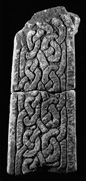
Object type: Shaft or furnishing, in two joining pieces
Measurements: H. 61 cm (24 in); W. 25.5 cm (10 in); D. 12.5 cm (5 in)
Stone type: Medium-grained, micaceous yellow sandstone (Carboniferous)
Plate numbers in printed volume: 398 - 401
Corpus volume reference: Vol 2 p. 122-123
(There may be more views or larger images available for this item. Click on the thumbnail image to view.)
This piece is formed as a half column which tapers slightly towards the top(?) where it widens with a horizontal projection. This is broken away, as is the other side, the top, and the base.
A (broad): The face is edged with an incised moulding which at the top right bends inwards at an angle to the projection. The face is ornamented by four and a half registers of complete, turned pattern A with outside strands. The knots are irregular and the strands tightly packed. The rounded section of the shaft is divided into three panels by plain roll mouldings.
B (narrow): Five volutes of a tightly coiled running spiral scroll with pellets or buds in the spandrels of the volutes.
C (narrow): A tapering panel of plain plait – at the top three-strand and at the bottom five-strand with an uneasy junction between.
D (narrow): Four volutes of a tightly coiled running spiral scroll with pellets as on B.
The shape of this piece is unique and much of the difficulty of interpreting it derives from the uncertainty of how to reconstruct the top. Collingwood (1927a, 8) considered that it might have been a unique form of cross modelled on a split tree trunk, just as other round shafts, such as those at Penrith or Gosforth, may be considered as modelled on wooden poles. He did not attempt to reconstruct the head form, however. The only form of cross-head which seems possible if one follows the lines of the mouldings is one like the late head on the cross from Cheadle, Cheshire (Collingwood 1927a, fig. 221). Similar stunted arms also occur on St Bees 2 (Ill. 551). At Hauxwell, Yorkshire, such projections are considered to have supported a wheel (Collingwood 1907a, 331 a–d).
If one considers that the form is diagnostic for the function of this piece, then it could be reconstructed as some form of church furnishing such as a reading desk. Such a function has been proposed for a piece from Kirby Moorside, Yorkshire, which is also of half columnar form and which has extended mouldings at each end (see Adcock 1974, II, 120–4, fig. 26). A similar function has been proposed for octagonal shafts from Jarrow, co. Durham (Cramp 1984, fig. 15) and Melsonby, Yorkshire (Cramp and Lang 1977, 18–21, fig., pls.). In all of these pieces the ornament is divided into narrow panels by heavy mouldings. The motifs of the Kirkby Stephen piece, although they have their roots in Anglian ornament, are clearly influenced by the fashions of the Viking Age: the two rows of irregular interlace patterns; the running spirals of tight, leafless scrolls and the plain plait with a changing cord count can all be paralleled on Viking-age monuments. In particular the form of scroll is common on hogback tombstones (see for example Penrith 6). If, then, one is to see this piece not as an aberrant cross shape but as a furnishing, then it is considerably later than any of the possible formal parallels.
