Select a site alphabetically from the choices shown in the box below. Alternatively, browse sculptural examples using the Forward/Back buttons.
Chapters for this volume, along with copies of original in-text images, are available here.


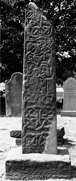
Object type: Part of cross-shaft and -base
Measurements:
Shaft: H. 200 cm (78.75 in); W. 48.5 > 40 cm (19 > 15.75 in); D. 27.5 > 23 cm (10.75 > 9 in)
Base: H. (max.) 43 cm (17 in); W. 86 cm (34 in); D. 65 cm (25.6 in)
Stone type: Medium-grained red sandstone (St Bees sandstone)
Plate numbers in printed volume: 582 - 5
Corpus volume reference: Vol 2 p. 151-152
(There may be more views or larger images available for this item. Click on the thumbnail image to view.)
Complete rectangular cross-shaft. All faces are bordered laterally by a roll moulding. The undecorated area below the ornamented panels is preserved on all faces.
A (broad): The face is divided into four panels. (i) At the top are two affronted or confronted beasts whose lower parts dissolve into pattern A knots. There are traces of contouring on the bodies and the raised wing of the animal to the left is enclosed within an interlace loop. (ii) Below a delicate roll moulding forming a panel border is a prancing profile animal, fettered and enmeshed in interlace, one of the strands formed by an extension of the tail. The animal has a bird-like head, with slit mouth and two small scooped ears. There are traces of contoured outline on the neck. (iii) Now devoid of any ornament or inscription though it is framed by both upper and lower border mouldings. (iv) Two registers of simple pattern E, each with two pairs of knots pointing upwards and downwards, and each with a central opposed break.
B (narrow): A full-length panel of interlace: three registers and parts of two others of simple pattern F. The lowest complete register is bungled, and the uppermost is a closed circuit version of the pattern.
C (broad): At the top are the remains of the moulding marking off the head from the single shaft panel below. The decoration on the shaft is divided by a vertical moulding into two parallel strips of unbalanced interlace, seven registers on the left, and six on the right. The left strip consists of half pattern A turned in various ways with alternation among the lower four and upper three registers. The right-hand strip, which is less regular, is based on turned half pattern A, but with bifurcating strands. There is an upper bar terminal. A small boss (bird's head') decorates a strand crossing towards the top of this strip. There may be traces of the incised body of an animal in the area below the interlace.
D (narrow): A full-length panel containing six registers of simple pattern F, the size of the registers varying considerably. At the top left corner one of the strands terminates in a bird-like head with extended jaws, a drilled eye and small pointed ear. The form of the terminals is unclear, but the upper one is probably a bar.
The Viking-period date is clearly established by several features of the ornament: bifurcating and closed circuit interlace, the contouring and the irregular interlace binding of the prancing animal on face A. It is likely also that there is a Scandinavian background for the use of decorative bosses marking the crossing of interlacing strands for woodwork carvings from Oseberg and York use decorative nails to achieve similar effects on zoomorphic and interlace ornament (Shetelig 1920, pls. IX–XIII; Roesdahl et al. 1981, pl. on 123).
Despite its Viking-period context however, the basic animal motifs derive from the vocabulary of Anglian art. Winged birds and animals whose lower parts dissolve into balanced interlace were already well established in Mercian art of the eighth and ninth centuries (for example, the Gandersheim Casket (Beckwith 1972, pls. 10, 13) or the 'Hedda' tomb at Peterborough (Smith 1923–4, fig. 4)) and the alert beast with puffed out chest and curved neck emerges from a similar background; they can be seen in late Anglian Northumbrian sculpture at Melsonby, Otley and Ilkley in Yorkshire and at Thornhill, Dumfriesshire (Collingwood 1927a, figs. 20, 23, 63, 68). This Waberthwaite cross thus represents an impressive fusion of Anglian and Scandinavian traditions, linked with a local taste for parallel strips of ornament.
