Select a site alphabetically from the choices shown in the box below. Alternatively, browse sculptural examples using the Forward/Back buttons.
Chapters for this volume, along with copies of original in-text images, are available here.


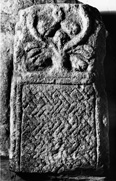
Object type: Part of cross-shaft and -head [1]
Measurements: H. 35.5 cm (14 in); W. 20 > 17 cm (8 > 6.75 in); D. 14 > 12 cm (5.5 > 4.7 in)
Stone type: Medium-grained, micaceous grey sandstone (Carboniferous)
Plate numbers in printed volume: 579 - 81
Corpus volume reference: Vol 2 p. 154-155
(There may be more views or larger images available for this item. Click on the thumbnail image to view.)
The shaft is edged by a double roll moulding, badly damaged on face B.
A (broad): Divided from a panel of straight line ornament is a plant scroll on what would have been the lower arm of the head. The plant is the lower half of a bold medallion scroll deeply cut and of a large scale in relation to the space that it has to fill. The two medallion strands spring from a single root and on either side of the root a pair of split leaves cascade down. At the base of the medallion is a small triangular bud on a stiff stem and on either side of it two indeterminate leaves or berries hang from twisted stems. The panel below is enclosed in an inner roll moulding and is filled by a straight line pattern.
B (narrow): One register and (probably) part of a second of alternating half pattern C with outside strands. The upper terminal is alternately joined.
C (broad): Not visible, but apparently cut away.
D (narrow): A register of simple pattern F with upper bar terminal.
This fragment is characteristic in many ways of the Cumbrian region. The preference for pattern F patterns of interlace has been noted in the Introduction (p. 17) and the combination of linear patterns and elaborate plant scrolls can be found also at Irton. The shallow straight line pattern has been compared with manuscripts such as the Book of Kells (Calverley 1899a, 281) and indeed, like Irton 1, this piece reflects a shallow complex ornament which may be manuscript-derived.
