Select a site alphabetically from the choices shown in the box below. Alternatively, browse sculptural examples using the Forward/Back buttons.
Chapters for this volume, along with copies of original in-text images, are available here.


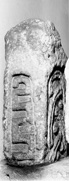
Object type: Part of cross-shaft [1]
Measurements: H. 48 cm (19 in); W. 32 cm (12.5 in); D. 14 cm (5.5 in)
Stone type: Medium-grained yellow sandstone (Carboniferous)
Plate numbers in printed volume: 586 - 8
Corpus volume reference: Vol 2 p. 155
(There may be more views or larger images available for this item. Click on the thumbnail image to view.)
Rectangular cross-shaft or possibly round-shaft derivative, type g. The lower part of the carving has been left undecorated for insertion into the ground. One incomplete panel remains on the three surviving faces, bordered laterally by a plain roll moulding; the bottom of the panel on the two broad faces is curved.
A (broad): Open stopped-plait with interspersed pellets; traces of a second parallel row of relief ornament alongside.
B (narrow): Recut.
C (broad): Now inaccessible; the drawing in Calverley 1891c suggests the presence of a fleshy spiral-scroll ornament.
D (narrow): Battlement pattern (Fig. 6d) with curled termination.
The curved lower frame of the panels on the broad faces probably reflects the influence of round-shaft derivatives (G.I., fig. 1g), whilst the use of stopped-plait and (apparently) spiral-scroll ornament suggest that this is the work of one of the more competent sculptors of the spiral-scroll school (Introduction, pp. 33–8).
