Select a site alphabetically from the choices shown in the box below. Alternatively, browse sculptural examples using the Forward/Back buttons.
Chapters for this volume, along with copies of original in-text images, are available here.


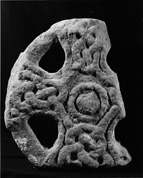
Object type: Part of cross-head
Measurements: H. 34.3 cm (13.5 in); W. 41.9 cm (16.5 in); D. 17.8 cm (7.0 in)
Stone type: Medium-grained red sandstone (St Bees sandstone)
Plate numbers in printed volume: 152 - 5
Corpus volume reference: Vol 2 p. 77
(There may be more views or larger images available for this item. Click on the thumbnail image to view.)
Cross-head, type E10, with ring, type 2b. Only faces A and C carry decoration.
A (broad): The ornament is surrounded by a flat-band moulding. At the centre is an encircled boss. Each surviving arm is filled with interlace made up from a pattern F element and a pair of included U-bend terminals with the strands connecting to adjacent arms.
C (broad): The face is framed by a flat-band moulding and an inner incised border; at the centre is an incised circle.
B and D (narrow): Plain.
Cross-heads with a plain face surrounded by simple mouldings have a long history in Anglian art (e.g. Whitby (Peers and Radford 1943, figs. 1 and 2)). Within the Anglian period the type is often combined with vine-scroll decoration (Cramp 1959–60, 16–17) but this particular combination with interlace seems, on present evidence, to be restricted to the Viking period. There is a very close parallel, both for shape and ornamental organization, across the Solway at Hoddom (Collingwood 1927a, fig. 154).
