Select a site alphabetically from the choices shown in the box below. Alternatively, browse sculptural examples using the Forward/Back buttons.
Chapters for this volume, along with copies of original in-text images, are available here.


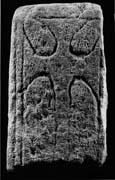
Object type: Part of grave-marker [1]
Measurements: H. 45.7 cm (18 in); W. 26 cm (10.25 in); D. 11 cm (4.3 in)
Stone type: Medium- to coarse-grained, very pale brown (10YR 7/4) grit; see no. 2.
Plate numbers in printed volume: 121-124
Corpus volume reference: Vol 3 p. 68-69
(There may be more views or larger images available for this item. Click on the thumbnail image to view.)
Only one broad face is decorated.
A (broad): The plain double edge moulding of narrow strips is lost on the right-hand side. The panel contains an incised cross intermediate between types B8 and B10 with narrow, curved arm-pits and widely splayed arms, which meet the edge mouldings.
B (narrow): Chiselled away.
C (broad) and D (narrow): Smoothly dressed.
The stone type and incised cross motif relate to the stelae series though the shape of the cross more closely resembles those of the incised markers at Wensley, North Riding, which Collingwood dated early (1927, 13, fig. 17, b–c), or even Tundwine's stone (no. 13) at Hexham, Northumberland (Cramp 1984, I, 181–2, II, pl. 178, 952). It is a development of the stelae (nos. 11–19).
1. All the pieces from the Minster were discovered as a result of the excavations of 1966-71 by H. Ramm and D. Phillips. They are to be published as a handlist, together with a critical essay, in the forthcoming Royal Commission volume on the excavations. That publication will provide the finer detail of their archaeological contexts, both in a table, and in a description of the excavation of the south transept cemetery.
The following are general references to the stones: Wilson 1978, 142; Hall 1980b, 7, 21; Lang 1988b, 8, 12; Lang 1989, 5.
