Select a site alphabetically from the choices shown in the box below. Alternatively, browse sculptural examples using the Forward/Back buttons.
Chapters for this volume, along with copies of original in-text images, are available here.


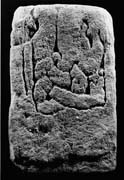
Object type: Grave-marker (end-stone) [1]
Measurements: H. 64.5 cm (25.4 in); W. 40.5 cm (16 in); D. 16.5 cm (6.5 in)
Stone type: Very coarse-grained (with quartzite pebbles up to 10 mm), very pale brown (10YR 7/4) grit; see no. 2
Plate numbers in printed volume: 125-128
Corpus volume reference: Vol 3 p. 69
(There may be more views or larger images available for this item. Click on the thumbnail image to view.)
A (broad): There is no edge moulding as such but the carving is inset rather unevenly. The lower part of the stone is undecorated. Two closely locked animals occupy the panel. The canine head of one appears in the lower right-hand corner, a pellet by the snout and a filler by the mouth. The neck is a kindred ribbon but is attached to the crouched torso under which its legs are folded. The knot in the neck is bungled. The other animal is crowded out.
B (narrow): Plain, with slight traces of indecipherable ornament at the top.
C (broad): The lower part is roughly hacked, and the ornament is inset, giving the appearance of a broad, flat edge moulding on each side. It consists of three parallel vertical strips of four-strand plain plait with irregular breaks. There is some bungling in the plaiting.
D (narrow): Plain.
Though this piece was found serving in the last pre-Conquest phase of the cemetery as a stumpy end stone, originally it is likely to have been a taller shaft. The ornament is conspicuously interrupted at the top. The interlocked beasts are typical of the York Metropolitan School, though here the design is both unambitious and inexpert. Its section is reminiscent of those grave-markers which evolved out of the stelae into flattish shafts, such as no. 21.
1. All the pieces from the Minster were discovered as a result of the excavations of 1966-71 by H. Ramm and D. Phillips. They are to be published as a handlist, together with a critical essay, in the forthcoming Royal Commission volume on the excavations. That publication will provide the finer detail of their archaeological contexts, both in a table, and in a description of the excavation of the south transept cemetery.
The following are general references to the stones: Wilson 1978, 142; Hall 1980b, 7, 21; Lang 1988b, 8, 12; Lang 1989, 5.
