Select a site alphabetically from the choices shown in the box below. Alternatively, browse sculptural examples using the Forward/Back buttons.
Chapters for this volume, along with copies of original in-text images, are available here.


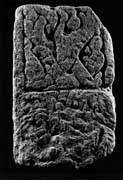
Object type: Grave-marker (end-stone) [1]
Measurements: H. 66.5 cm (26.2 in); W. 39.5 cm (15.5 in); D. 17 cm (6.7 in)
Stone type: Very coarse-grained (with quartzite pebbles up to 10 mm), feldspathic, very pale brown (10YR 7/4) grit; see no. 2
Plate numbers in printed volume: 129-132
Corpus volume reference: Vol 3 p. 69
(There may be more views or larger images available for this item. Click on the thumbnail image to view.)
A (broad): In the upper half, a plain tapering edge moulding flanks two interlocked beasts. The rump of one lies in the left-hand corner, its waist crossed by the knotted neck of the other animal. Its fore parts are canine with traces of a mane. The other beast's body is lost except for the neck, knotted in a ring and strand with a split terminal, and the head, which points up the stone. The snout has a nose-fold and a protruding tongue. The eye is incised. The lower part of the stone is undecorated and roughly hacked.
B and D (narrow): Plain.
C (broad): The lower portion is uncarved and the edge moulding of the upper part is identical with that of face A. The panel consists bold but ill-planned and irregular interlace using broad, flat strands. The central loop at the bottom hangs below the base of the design. There is no formal edge moulding.
The zoomorphic panel is very close to that of no. 30. The clumsy interlace is even less controlled. Both pieces are less accomplished than the majority of slabs and shafts in the graveyard carrying animal ornament. The nose-fold and interlocking of the beasts are features of the York Metropolitan School and derive from the Scandinavian input to tenth-century animal ornament.
1. All the pieces from the Minster were discovered as a result of the excavations of 1966-71 by H. Ramm and D. Phillips. They are to be published as a handlist, together with a critical essay, in the forthcoming Royal Commission volume on the excavations. That publication will provide the finer detail of their archaeological contexts, both in a table, and in a description of the excavation of the south transept cemetery.
The following are general references to the stones: Wilson 1978, 142; Hall 1980b, 7, 21; Lang 1988b, 8, 12; Lang 1989, 5.
