Select a site alphabetically from the choices shown in the box below. Alternatively, browse sculptural examples using the Forward/Back buttons.
Chapters for this volume, along with copies of original in-text images, are available here.


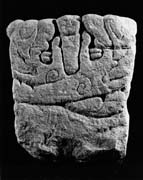
Object type: Grave-marker (end-stone) [1]
Measurements: H. 37.5 cm (14.75 in); W. 33 cm (13 in); D. 14.7 cm (5.75 in)
Stone type: Medium-grained grit, burnt red (2.5YR 5/6); see no. 2.
Plate numbers in printed volume: 133-137
Corpus volume reference: Vol 3 p. 70
(There may be more views or larger images available for this item. Click on the thumbnail image to view.)
A and C (broad): The monument is formed by two interlocking beasts in three dimensions, carved in low relief on the broad face. The large, confronted heads are canine, with small, rounded, pricked ears, and incised elliptical eyes. The jowl is defined by a curved, incised line, with the lower jaw slightly receding. The nape is maned with tendril locks. A small fore leg is raised vertically to the jowl, extending from an incised spiral on the chest which is turned upwards. The torsos overlap and taper sharply.
Between the jowls is a small vertical figure with the incised features of a human face; no limbs are visible. The lower portion of the stone is scabbled.
B and D (narrow): The ears of the three-dimensional animals are separated by a broad incision. The nape is plain and the narrow termination of the animal's body is marked by two deep half incisions.
E (top): The ears stand proud, separated by a deep cut. The brow and jowl appear as plain parallel strips. The heads of the two small central figures are cut free from behind from a central strip.
The stone was found in situ, serving as a headstone (Hope-Taylor 1971, pl. 9, 26). Unlike other end-stones this one, and no. 33 are not reused fragments of recumbent slabs, and stylistically they are distinct from those parallel monuments. However, the confronting beasts with manes about to consume the small frontal face seem to derive from the design of the ends of the slabs, especially when compared with the broken, vertically erected no. 36. The large winged profile beasts of that stone press upon the small terminal head of the superimposed cross, providing a more schematized model for this head-stone (Lang 1978b, 152–3; idem 1978c, 20). Here the design is looser and so derivative that an internal chronology is implied between it and the slab sequence. The custom of laying out slabs with end-stones was common in the Minster cemetery and reflects the usage involving hogbacks and standing crosses (Lang 1984a, 96–7). The habit continued into the Romanesque period when it was current at Whitby Abbey, North Riding.
1. All the pieces from the Minster were discovered as a result of the excavations of 1966-71 by H. Ramm and D. Phillips. They are to be published as a handlist, together with a critical essay, in the forthcoming Royal Commission volume on the excavations. That publication will provide the finer detail of their archaeological contexts, both in a table, and in a description of the excavation of the south transept cemetery.
The following are general references to the stones: Wilson 1978, 142; Hall 1980b, 7, 21; Lang 1988b, 8, 12; Lang 1989, 5.
