Select a site alphabetically from the choices shown in the box below. Alternatively, browse sculptural examples using the Forward/Back buttons.
Chapters for this volume, along with copies of original in-text images, are available here.


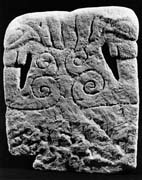
Object type: Grave-marker (end-stone) [1]
Measurements: H. 54.6 cm (21.5 in); W. 43.8 cm (17.25 in); D. 16.5 cm (6.5 in)
Stone type: See no. 2.
Plate numbers in printed volume: 138-141, 143
Corpus volume reference: Vol 3 p. 70-71
(There may be more views or larger images available for this item. Click on the thumbnail image to view.)
A (broad): Two addorsed demi-beasts occupy the top of the stone, incised on the face and in three dimensions on the top. The heads face outwards, the jowls pointing down, flat-tipped with straight incised mouths. The brow is formed by a curving line which lifts the upper part of the head into low relief. The incised eye is elliptical. The nape, on the crest of the monument, has a wave of tendril locks. A stubby fore leg, without a distinct paw, is raised to touch the jowl, stemming from an incised loose spiralled joint. An extended scroll branches from the joint spiral. The lowest portion of the stone is scabbled.
B (narrow): The only decoration is a series of simple horizontal divisions corresponding with the body areas of the beast.
C (broad): Identical with face A except for the absence of the extended scroll branching from the joint spiral.
D (narrow): Identical with face B, except that there is a vertical division with a horizontal one at its base in addition to the horizontal ones at the top.
E (top): A central transverse incision crosses three strips.
The stone closely resembles no. 32, though the beasts are turned and there is no central human figure. Since it was used in association with that monument it is tempting to see them as a pair. This, however, is unlikely since, they embraced a reused earlier stone, and the stylistic differences would be unlikely in a pairing of such symmetrical pieces.
The deeply cut slots under the jowls of the animals were once speculatively interpreted as mortices for wooden coping planks (Lang 1978b, 152) but this is unlikely as the feature occurs on both faces.
1. All the pieces from the Minster were discovered as a result of the excavations of 1966-71 by H. Ramm and D. Phillips. They are to be published as a handlist, together with a critical essay, in the forthcoming Royal Commission volume on the excavations. That publication will provide the finer detail of their archaeological contexts, both in a table, and in a description of the excavation of the south transept cemetery.
The following are general references to the stones: Wilson 1978, 142; Hall 1980b, 7, 21; Lang 1988b, 8, 12; Lang 1989, 5.
