Select a site alphabetically from the choices shown in the box below. Alternatively, browse sculptural examples using the Forward/Back buttons.
Chapters for this volume, along with copies of original in-text images, are available here.


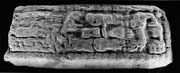
Object type: Grave-cover [1]
Measurements: L. 130 cm (51 in); W. 47.3 cm (18.6 in); D. 28.3 cm (11 in)
Stone type: Coarse- to very coarse-grained, very pale brown (10YR 7/4) grit; see no. 2.
Plate numbers in printed volume: 142, 144-147
Corpus volume reference: Vol 3 p. 71-72
(There may be more views or larger images available for this item. Click on the thumbnail image to view.)
A (top): There is a continuous broad moulding in cable running round the surviving three sides. Within the panel is worn free-style carving, evidently intended to be viewed with the surviving narrow side at the bottom. It is described from that position in what follows. At the bottom lies an S-shaped dragon, its head in the corner. Above it on the right, is a profile standing human with his hand raised to his mouth. Before him is a triangle above which he holds a horizontal bar. Opposite him is a headless torso. Over the head of the complete figure is a quadruped seen in profile. Other sub-rectangular features fill the panel but are indecipherable. Above all this is a standing, frontal figure between worn decorative borders.
B (long side): The upper edge moulding is cabled; the other two remaining edges are flat. The panel contains a changing interlace pattern of closed circuit motifs and plain plait using median-incised strands. The units are separated by short glides. From left to right they comprise: two free rings and long diagonals with pellet filler below; a unit of simple pattern F; two free rings threaded with two pairs of opposing diagonals, separated by a short glide; and two short runs of six-strand plain plait, the intervening glide being rather bungled.
C (end): Within the chipped edge moulding two profile animals engage in combat, one on its back and possibly with a double outline. Between them and the panel edge is a squatting bear-like animal seen in profile.
D (long side): The upper moulding is cabled whilst the other two surviving edges are flat and broad. In the centre of the panel a human figure in profile, with widely spread legs, holds an upright sword. To the left of this is a knotted serpentine dragon. Its jaws gape at the swordsman. Its body passes through a free ring, then forms a Stafford Knot with sharp projecting fin, before ending in a splayed fish-tail. To the right a similar dragon is seen from above. It has three pairs of fins, one behind the head, and its body forms two Stafford Knots, the other fins projecting from each of these. Both dragons have median-incised ribbon bodies. At the human's feet is a severed dragon's head.
E (end): Broken away.
The York Minster cemetery has a large series of flat grave-covers which were used in association with upright end-stones. Many seem to have been carved from the large Roman building blocks already on the site of the headquarters building, and this source may have determined their size and shape: even the necessity for end-stones to cover the length of the grave space.
The interlace patterns, notably the ring-twist, are indicative of Anglo-Scandinavian taste. The animal combat of face C reflects the looser versions of zoomorphic ornament which are found on one panel of St Denys 2 (Ill. 213). The dragons of face D and the base of face A are identical with the knotted serpent of the cross-head, St Mary Castlegate 2 (Ill. 297). The two monuments may be by the same hand.
The other long side and the top undoubtedly depict the Sigurð story of the killing of the dragon Fáfnir in a pit, the roasting of its heart, the decapitation of Reginn, and the loading of the horse Grani. The parallels for this iconography lie in the cross-slabs of the Isle of Man and on Yorkshire crosses at Kirby Hill, North Riding, and Ripon, West Riding (Lang 1976). The Sigurð legend is confined strictly to these areas and to Halton, Lancashire, when it is carved in stone. (For its context, see Chap. 9; Calverley 1899, 186, fig. facing; Ellis 1942; March 1891; Kermode 1907, 170 ff.; Ploss 1966; Davidson 1950). The present slab carries the greatest number of elements in the story, even compared with Halton, outside the Manx series. The legend is heroic rather than pagan, and such iconography could have been compatible with Christianity. It is however, confined to a very narrow line from Man, through North Lancashire, to Yorkshire. The iconography of the Yorkshire Sigurð scenes has been scrutinized by Margeson (1980, 190–1, 209). For narrative sculpture like this the free style is adopted, as on face A, in the Manx manner: compare, for example, the roasting scene on that face with the one on a stone from Andreas (Ill. 913). Only the dragons on the side have any stylistic elements, and those are primitive.
1. All the pieces from the Minster were discovered as a result of the excavations of 1966-71 by H. Ramm and D. Phillips. They are to be published as a handlist, together with a critical essay, in the forthcoming Royal Commission volume on the excavations. That publication will provide the finer detail of their archaeological contexts, both in a table, and in a description of the excavation of the south transept cemetery.
The following are general references to the stones: Wilson 1978, 142; Hall 1980b, 7, 21; Lang 1988b, 8, 12; Lang 1989, 5.
