Select a site alphabetically from the choices shown in the box below. Alternatively, browse sculptural examples using the Forward/Back buttons.
Chapters for this volume, along with copies of original in-text images, are available here.


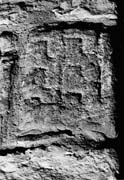
Object type: Part of cross-shaft [1]
Measurements: H. 35 cm (13.75 in); W. 25 cm (9.8 in); D. 24 cm (9.5 in)
Stone type: Coarse-grained, slightly feldspathic, white (10YR 8/2, with brownish-yellow (10YR 6/6) flecks) grit; see no. 1.
Plate numbers in printed volume: 261-262
Corpus volume reference: Vol 3 p. 90
(There may be more views or larger images available for this item. Click on the thumbnail image to view.)
Only two faces are visible.
A (broad): Within a plain edge moulding are two runs of step pattern 1, lying adjacent to each other.
B (narrow): A plain edge moulding flanks one run and part of an adjacent one of broad step pattern 1.
Step patterns are common throughout Yorkshire on narrow fields of Anglo-Scandinavian monuments, for example, along the ridges of hogbacks. Adjacent parallel strips of the pattern are less usual, but occur after a fashion at Aberford in the West Riding (Collingwood 1915, 130–1, fig. h) and at Glassonby, Cumbria (Bailey and Cramp 1988, ill. 287) This is unadventurous work.
