Select a site alphabetically from the choices shown in the box below. Alternatively, browse sculptural examples using the Forward/Back buttons.
Chapters for this volume, along with copies of original in-text images, are available here.


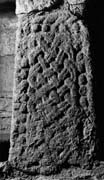
Object type: Part of cross-shaft [1]
Measurements: H. 60.5 cm (23.8 in); W. 34 cm (13.4 in); D. 22 cm (8.7 in)
Stone type: See no. 1.
Plate numbers in printed volume: 263-265
Corpus volume reference: Vol 3 p. 90
(There may be more views or larger images available for this item. Click on the thumbnail image to view.)
Only three faces are visible.
A (broad): A cabled moulding, 2.5 cm wide, runs round the top of the panel. Within it is a run of bold pellets forming an internal border to a panel of interlace, using flat median-incised strands: a six-strand plain plait.
B (narrow): The cable and pellet edge mouldings are as on face A, but survive only on the left. The fragmentary panel has rather open interlace using deeply cut median-incised strands: a four-strand plain plait. The profile of the strands consists of chamfered sides and a flat top.
C (broad): Built in.
D (narrow): The mouldings are as on face A, but survive only on the right. There are remains of interlace using median-incised strands: probably a four-strand plain plait.
The bold pellets are typical of many second-rate shafts from York, and this, in combination with the interlace types, links it to the Plait and Pellet Group (see Chap. 10). All the interlace patterns employed on this piece are easy to produce, the chunky cutting giving a bold appearance which belies their quality. It is evidently the top of a tapering shaft. It cannot have been part of no. 1, as has been suggested (Moulden and Tweddle 1986, 27), since the cutting is so different.
