Select a site alphabetically from the choices shown in the box below. Alternatively, browse sculptural examples using the Forward/Back buttons.
Chapters for this volume, along with copies of original in-text images, are available here.


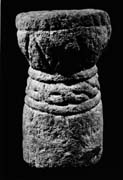
Object type: Candlestick or cresset
Measurements: H. 23 cm (9 in); Diameter 13 cm (5 in)
Stone type: Medium-grained, very pale brown (10YR 7/3) grit; Millstone Grit, Namurian, Upper Carboniferous; reused Roman ashlar, originally from Hetchell Crag (Thorner) or Otley areas (see Fig. 5).
Plate numbers in printed volume: 397-398
Corpus volume reference: Vol 3 p. 114
(There may be more views or larger images available for this item. Click on the thumbnail image to view.)
The cylindrical stem is plain until it begins to taper. There is a horizontal band of ornament, which may be interpreted either as step pattern 2, or simple twist, between flat mouldings. Rising out of this collar is a hemispherical bowl, again decorated with ambiguous incised ornament: either a band of simple chevron, or pendant Van Dykes. There may have been small upright leaf forms in the interstices. The lip of the bowl is in bold cable. Within the bowl the proud rim is plain and in the hollowed interior are faint radiating incisions.
This is a rarity. Stone cressets are found from the early medieval period in Ireland and Wales. The Van Dykes, if such they be, are skeuomorphs of the applied triangular plates on metalwork vessels.
