Select a site alphabetically from the choices shown in the box below. Alternatively, browse sculptural examples using the Forward/Back buttons.
Chapters for this volume, along with copies of original in-text images, are available here.


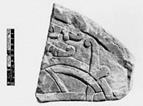
Object type: Grave-marker
Measurements: H. 19 cm (7.5 in); W. 17 cm (6.7 in); D. c. 11 cm (c. 6.2 in)
Stone type: Pale yellowish-brown, fine-grained sandstone, even-grained with a slightly friable 'sandrock' texture; Hastings Beds division of the Wealden Group, Lower Cretaceous
Plate numbers in printed volume: Pl. 1; Ills. 147-150
Corpus volume reference: Vol 4 p. 166-167
(There may be more views or larger images available for this item. Click on the thumbnail image to view.)
Approximately one quarter of a semicircular headed monument; the only original edge is part of the curve of the head, now forming one side of a roughly triangular fragment. The remaining faces are roughly broken.
A (broad): There is a broad plain border along the curved edge. The rest of the face is decorated in the Ringerike style in low, flat relief with what may be plant tendrils or lappets from an animal's body. These are sometimes paired, having clubbed ends, and often with subsidiary lobes developing from them close to their ends.
B, D and E (narrow sides and top): The two outer strips beyond the incised framing lines are coloured red. No colour is now visible to the naked eye either within the inscribed field or in the grooves of the letters.
Inscription The fragmentary inscription (Okasha 1992a, 52) is incised along the flat surface of the curving outer rim (Ills. 149–50), which is set at right angles to faces A and C. The letters are carved within the field defined by two parallel incised lines that run about 6.6 cm (2.75 in) apart. The surviving letters are between 3.8 and 4.3 cm (1.5 and 1.7 in) high. The inscription is incomplete at either end. The surviving letters are capitals and can be transcribed:
--[E]+[A]ME[.]--
The first letter is clearly E but it could perhaps be in ligature with another letter or be part of the diphthong Æ. The next character, which consists of a cross set within a pointed oval, was probably intended as a cross. The fragmentary letter at the end could be either N or M. If it is taken as N, the following reading is possible:
--E + AME[N ]--
The inscription might then be interpreted as the word amen at the end of a brief prayer. The language of the rest of the text is uncertain.
The lettering is cut with even and shallow grooves. Strokes are finished either with very slight serifs or with none at all. The following capital forms are used: A with no cross-bar but with a long bar over the top (of which only the seriffed ends remain); a very narrow form of E; a broader form of E (unless it is part of the diphthong Æ); M with vertical outer strokes and a central 'V' which occupies slightly more than half the height of the letter.
C (broad): The border is similar to that on face A. The face is decorated with one arm of a cross with the outer end terminating against it. The arm, in low, flat relief, expands regularly towards the outer end, and is defined by a narrow incised line paralleling the edges. On one long edge this has been lost by the later break. In the outer corners of the cross-arm, an arc defined by a pair of parallel incised lines links the frames, and a single incised line cuts each of them. This feature is partially obscured in the broken corner.
This is probably part of a semicircular head- or foot-stone of the type encountered at Whitchurch, Hampshire, Stedham, Sussex (nos. 7, 10–11), and at Winchester (New Minster 2 and St Pancras 1). The piece is probably thick enough to have sat directly on the surface without having been sunk into the ground. It is impossible to tell which face is the front and which the back. If the inscription was read from the foot of the grave, then the tendril-decorated side (face A), would have faced the front, but there can be no certainty that this was so. It is, however, suggestive that this is the face with the most elaborate colour scheme.
It is possible partially to reconstruct the original decoration of face A. The thicker strand to the bottom left of the face, with an incised line paralleling its outer edge, is suggestive of an animal body; the animal bodies on a number of Ringerike-style pieces, such as the vane from Kallunge, Sweden (Fuglesang 1980, no. 44, pls. 24–5), or the slab from Husaby church, Sweden (ibid., no. 74, pl. 44b), take precisely this form. The tight curve of the body on 3A suggests that the animal originally had a coiled body, a form familiar in the Ringerike style in England as, for example, on two panels of the disc brooch from Sutton in the Isle of Ely (ibid., no. 50, pl. 28) and an initial D from the Winchcombe Psalter (ibid., no. 109, pl. 70c). If the main decorative feature of this face was an animal, then the pair of tendrils developing from the broken edge to the left towards the head of the stone fall into place quite naturally as lappets developing from the back of the animal's head, a form encountered on the St Paul's stone (Ill. 351) and which is commonplace in the Ringerike style both in England and elsewhere. The feature is employed, for example, in the manuscript initial cited above, and on the front of the vane from Heggen, Norway (ibid., no. 42, pl. 22). Not enough of the present piece survives for a complete reconstruction of the decoration of face A to be attempted, but its main outline as a coiled animal with the head at the top of the stone facing left seems clear enough.
Together with Rochester Cathedral no. 2, it is probable that this piece was part of the group of Ringerike-style pieces from the region, embracing London (St Paul's 1, All Hallows by the Tower 3, and City 1) and Great Canfield 1, Essex. All of them may be products of a single workshop, given their restricted distribution and uniform style of carving. It is noteworthy that three pieces in this group, the present piece and no. 2 from this site, and London (All Hallows) 3, take the form of two-sided head- or foot-stones, a form rarely encountered in the region outside the group.
Inscription The form of the A (with a top bar but no cross-bar) is fairly unusual but it occurs on a small number of Anglo-Saxon inscriptions that probably all date from between the ninth and eleventh centuries (Okasha 1968, 322–8). Canterbury St Augustine's 2 also has an example of A without a cross-bar, but that letter lacks the pronounced top bar seen here. The Ringerike ornament on one face of the stone allows the lettering to be dated with some probability to the first half of the eleventh century. Okasha compares the cross to one on an early inscribed stone on Lundy Island (Okasha 1992a, 52; eadem 1993, fig. II, 26). In that case, however, the cross is contained within a circle. It is a form which also appears on uninscribed stones from early medieval Wales (Nash-Williams 1950, fig. 5.1).
If the fragment is part of the head- or foot-stone from a grave, the positioning of the text on the outer upward-facing curving rim can be compared with the headstone in Whitchurch, Hampshire (Ills. 482, 485–9). If the monument was funerary, the inscription was probably some form of memorial text.
Texts with the word amen seem not to have been common on Anglo-Saxon inscribed stones. There is a Latin memorial text ending with the word amen on the cross-base from Haddenham (Cambridgeshire) but certain oddities about this inscription raise doubts about its pre-Conquest date (Okasha 1971, 74–5; Higgitt 1986, 130). Another possible example is the Latin inscription ending with amen on the font at Potterne in Wiltshire (Okasha 1983, 96–7), which probably dates from the late Anglo-Saxon period but could be a little later.
The cross before amen is in part punctuation and in part an invocation of the deity. Crosses are sometimes used in Anglo-Saxon inscriptions to mark the start of a new section of text as, for example, on the grave-cover at Stratfield Mortimer (Ill. 708). The invocatory function is clear in the multiple crosses in the epitaph on the cross from Yarm, Yorkshire (Okasha 1971, 130).
