Select a site alphabetically from the choices shown in the box below. Alternatively, browse sculptural examples using the Forward/Back buttons.
Chapters for this volume, along with copies of original in-text images, are available here.


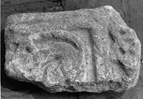
Object type: Decorative panel [1]
Measurements: H. 18 cm (7 in); W. 32 cm (12.6 in); D. 11 cm (4.3 in)
Stone type: Yellowish-grey, medium-grained, shelly, oolitic limestone, with scattered 0.9-mm pellets; possibly Barnack stone
Plate numbers in printed volume: Ill. 146
Corpus volume reference: Vol 4 p. 167-168
(There may be more views or larger images available for this item. Click on the thumbnail image to view.)
It is sub-rectangular. The upper edge is horizontally dressed, the left-hand edge vertically broken, and the right-hand edge roughly broken and projecting prominently. The lower edge is roughly broken and rises slightly from right to left.
A (broad): A plain vertical relief moulding divides the face into two fields, that to the left three times larger than that to the right, and unites with a plain, low-relief border along the upper edge of the panel. To the right of the junction this is narrow, but to the left doubles in width, and has a median-incised line. In the right-hand field two V-shaped interlace bands, the upper overlapping the lower, develop from the right, their apices touching the vertical border. In the left-hand field are the well-modelled hindquarters of a slender animal facing to the left. The body tapers to the right, and the back is concave before curving up over the hindquarters. The nearside thigh tapers straight down, and the offside thigh angles to the left. The slender tail curves up and over the hindquarters, touching the upper border before encircling the body and being carried off to the upper left.
The original function of this piece is almost impossible to identify, particularly as only one original edge may survive. The shape of the piece is not consistent with it having been a cross-shaft, and the nature of the decoration does not correspond with that encountered among the grave-covers of south-east England. The probability is that it was architectural in function.
The date of the fragment is equally difficult to define. Thin animals with bulbous thighs and the tails looping round the body occur on fol. 11r of the mid eighth-century Codex Aureus, although also enmeshed in interlace (Alexander 1978, no. 30, ill. 152). Similar animals are, however, encountered in later works, as, for example, on fol. 1v of the Vita Cuthberti, dated to c. 937 (Temple 1976, no. 6, ill. 29), and fol. 57r of Durham Cathedral Library MS A. IV. 19, dated to the early eleventh century (ibid., no. 3, ill. 8).
