Volume 4: South-East England
Select a site alphabetically from the choices shown in the box below. Alternatively, browse sculptural examples using the Forward/Back buttons.
Chapters for this volume, along with copies of original in-text images, are available here.
Current Display: Romsey 01, Hampshire 

Overview
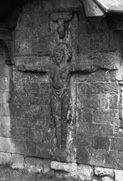
Object type: Crucifixion [1]
Measurements: H. 225 cm (88.5 in); W. (across arms) 179 cm (70.5 in); D. Built in
Stone type: Greyish-yellow, medium- to coarse-grained, shelly, oolitic limestone with calcite veinlets; Combe Down Oolite, Great Oolite Formation of the Bath area, Great Oolite Group, Middle Jurassic
Plate numbers in printed volume: Ills. 451-452, 456
Corpus volume reference: Vol 4 p. 261
(There may be more views or larger images available for this item. Click on the thumbnail image to view.)
Present Location
Built externally into the west wall of the south transept
Evidence for Discovery
First recorded by J. Carter in 1781
Church Dedication
abbey, St Mary
Present Condition
Chipped and weathered
Description
The cross is composed of three stones, one forming the vertical and two others the horizontal limbs. The figure is frontally placed with the arms out-stretched horizontally, and the legs straight. The figure has a cruciform nimbus, and looks slightly to the left. The top of the head is dressed flat, and the face is bearded, although the other facial features are heavily weathered. The figure is naked to the waist, and the musculature of the chest and arms is well modelled, a short section of the figure's right upper arm being cut away, and the left hand and forearm extensively damaged. The figure wears a knee-length robe clinging tightly to the thighs, and with the upper edge falling in a triangular fold between the legs. The legs are well modelled, and the feet placed side by side on a suppedaneum having a downward-sloping upper face. Above the figure the Hand of God issues from a cloud forming a lobe on either side of the sleeved wrist, the texture of the cloud is indicated by tight relief scrolls. The upper edge of the cloud is co-terminus with the upper edge of the vertical limb of the cross.
Discussion
The flattening of the head of the figure and the absence of the upper arm of the cross within the nimbus strongly suggest the original presence of a metal crown, later removed. As noted above (Chap. VII), there is good documentary evidence for the use of metal crowns with pre-Conquest crucifixion groups. The crucifixion may originally also have had accompanying figures as at Breamore 1 (Ill. 425), Langford 1, Oxfordshire (Ill. 293), and Headbourne Worthy 1 (Ills. 448–50), but if so, no trace of them remains. The figure of Christ is in repose, a type encountered elsewhere in south-east England only at Headbourne Worthy 1, Hampshire. For further discussion, see Chap. VII.
Date
Tenth century
References
Carter 1780 - 94, i, pl. II; Spence 1841, 22 - 3; Carter 1845, 2; Twining 1852, 6, pl. II.25; Ashpitel 1846, 422 - 3, fig. on 423; Allen 1887, 164, fig. 45; Hill 1898, 86; Yarborough 1898 - 1903, 228; Marshall 1900, 166 - 7; Doubleday and Page 1903, 240; Keyser 1904, liii; Liveing 1906, 36 - 7; Mason 1907, 260; Perkins 1907, 32 - 4, pl. on 33; Dalton 1908, 229; Page 1911, 398, 467; Prior and Gardner 1912, 133, 137, fig. 113; Thompson 1924, 337; Longhurst 1926, 22; Clapham 1930, 138, pl. 61; Cottrill 1931, 52, appendix; Casson 1932, 273 - 4, pl. IIA; Casson 1933, 35; Rivoira 1933, ii, 208, fig. 640; Rice 1947, 9, 13 - 14, frontispiece; Cox and Jowitt 1949, 22, 142, 180, pl. 41; Kendrick 1949, 48 - 50; Clapham 1951, 192 - 3, pl. IIa; Gardner 1951, 45 - 6, fig. 71; Green and Green 1951, 33 - 43, pl. XB; Zarnecki 1951a, 152; Rice 1952, 83, 85, 98 - 9, pl. 13; Stone 1955, 40 - 1, pl. 21; Poole 1958, 491; Fisher 1959, 89; Rice 1960, 198, pl. IIA; Quirk 1961, 29; Fisher 1962, 393; Pocknee 1962, 65; Taylor 1962a, 169; Taylor 1962b, 19; Taylor and Taylor 1965 - 78, ii, 521 - 2; Radford 1966c, 219 - 20; Taylor and Taylor 1966, 1; Zarnecki 1966, 89, 92, 98; Pevsner and Lloyd 1967, 17, 486; Cramp 1972, 146, taf. 69.2; Gem 1973, ii, 496 - 7; Cramp 1975, 198; Coatsworth 1979, i, 281 - 5, ii, 41 - 2, pl. 141; Dodwell 1982, 118; Service 1982, 177; Fernie 1983b, 150; Rodwell and Rouse 1984, 318; Wilson 1984, 196, pl. 257; Tweddle 1986b, i, 73 - 5, 189 - 208, ii, 449 - 50, iii, pls. 80 - 81a; Coatsworth 1988, 167 - 9, 191 - 2, pls. 1a - b; Raw 1990, 58, 118, 129, 150 - 1, 242
D.T.
Endnotes
